
When it comes to securing pallets, cartons, steel coils, or any bulky shipment, the right strapping material can save manufacturers thousands of rupees in damaged goods, re-strapping costs, and transit claims. The two most widely used plastic strapping options in Indian industries today are PET (Polyester) Strap and PP (Polypropylene) Strap.
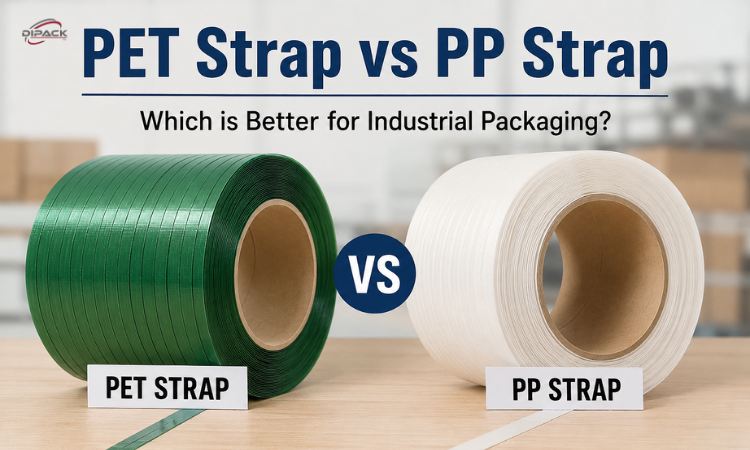
But here is the real question every manufacturer, factory owner, and packaging head asks — PET Strap vs PP Strap: which one is actually better for industrial packaging?
The honest answer is, it depends on your load weight, transit distance, storage conditions, and budget. In this guide, we will break down both materials in simple language so you can make a confident, cost-effective decision for your packaging line.
What is PP Strap?
PP Strap, short for Polypropylene Strap, is a lightweight thermoplastic strapping material made from polypropylene resin. It is the most common strapping band used across e-commerce, FMCG, food packaging, courier services, and light manufacturing.
PP straps are flexible, easy to handle, and available in a range of widths (typically 6mm to 19mm). They come in multiple colours, which helps companies colour-code shipments or match their brand identity.
Key features of PP Strap:
- Light to medium-duty load handling
- High elongation and flexibility
- Affordable per-roll pricing
- Works with both manual hand tools and semi/fully automatic strapping machines
- Suitable for indoor storage and short-distance transport
PP strap is the budget-friendly workhorse of Indian packaging lines, especially in carton bundling and box-level strapping operations.
What is PET Strap?
PET Strap, also called Polyester Strap, is a high-tensile strapping material manufactured from polyethylene terephthalate — the same family of resin used in PET bottles. It has a denser molecular structure than PP, which gives it much higher rigidity, strength, and tension retention.
PET straps are widely considered the best plastic alternative to steel strapping. They hold heavy loads securely without losing tension over long transit periods, making them ideal for export shipments, heavy industrial loads, and outdoor storage.
Key features of PET Strap:
- High tensile strength (often replaces steel strapping)
- Excellent tension retention over weeks and months
- Strong UV, moisture, and temperature resistance
- Available in widths from 9mm up to 32mm for heavy-duty needs
- Safer than steel — no sharp edges, no rusting, no operator injuries
PET strap is the preferred choice for steel coils, bricks, timber, automotive parts, aluminium sections, and any palletised heavy load that must survive long journeys.
PET Strap vs PP Strap: Quick Comparison Table
Here is a side-by-side look at how both materials stack up. This is the fastest way to understand the difference at a glance.
Feature | PP Strap (Polypropylene) | PET Strap (Polyester) |
|---|---|---|
Tensile Strength | Low to Medium | High (steel-replacement grade) |
Best For | Light to medium loads | Medium to heavy loads |
Elongation | High (more stretchy) | Low (rigid hold) |
Tension Retention | Loses tension over time | Holds tension for long periods |
UV Resistance | Low | High |
Temperature Resistance | Moderate | Excellent (up to 200°C) |
Cost per Roll | Lower | Higher |
Common Width | 6mm – 19mm | 9mm – 32mm |
Ideal Storage | Indoor, short-term | Indoor and outdoor, long-term |
Eco-Friendly | Recyclable | Highly recyclable (often from PET bottles) |
Best Industries | E-commerce, FMCG, courier, food | Steel, automotive, construction, exports |
Strength and Tensile Capacity
This is the single biggest reason manufacturers compare these two materials in the first place.
PP Strap typically offers a break strength suitable for cartons, light cases, and parcels under 40–50 kg. It stretches more, which means it can absorb minor shocks during handling, but it cannot hold heavy or rigid loads tightly for long.
PET Strap, on the other hand, can secure loads exceeding 600 kg in many specifications. Its low elongation means once it is tensioned, it stays tensioned. For heavy palletised goods, bricks, marble slabs, steel rolls, or machinery parts, PET is the only plastic option that comes close to steel strapping performance.
Real-world takeaway: If your shipment shifts, settles, or compresses during transit, PET will recover and continue to hold. PP simply cannot.
Cost and Long-Term Value
On the surface, PP strap looks like the cheaper option — and per metre, it is. But experienced procurement managers know that strapping cost is not just about the price of one roll. It is about the total cost of ownership.
Here is what really impacts your packaging budget:
- Re-strapping cost: PP straps that lose tension during transit often need re-strapping at warehouses or distribution centres. That is extra labour, extra time, and extra material.
- Damage claims: Loose loads cause product damage. According to global cargo bodies, nearly 65% of cargo damage claims come from poor packaging practices.
- Labour and machine time: A strap that breaks during application interrupts your packaging line.
For light loads, PP gives excellent value. For heavy, high-value, or long-distance shipments, PET pays for itself many times over by preventing claims and rework. The wise approach for most factories is to stock both — PP for inner cartons and PET for final pallets
Weather, UV and Temperature Resistance
Indian conditions are tough on packaging. Goods may sit at a port in Mumbai under the sun, then travel through humid coastal routes, then end up in cold-chain warehouses or international containers. Strapping material has to survive all of this.
PP Strap has moderate resistance. Long sun exposure weakens it, and it loses tension faster in heat. It is best used indoors or for short-cycle dispatches.
PET Strap is built for the outdoors. It resists UV light, holds up in extreme heat and cold, and does not degrade in humidity. This is why exporters, construction suppliers, and outdoor-storage industries almost always specify PET.
If your goods stay strapped for more than a few days, or if they are exposed to sun or weather at any stage, PET is the safer choice.
Application and Industry Use
The clearest way to settle the PP vs PET question is to match the strap to the industry. Here is how Indian manufacturers typically choose:
Choose PP Strap if you are in:
- E-commerce and parcel courier services
- FMCG, food, beverages, and confectionery
- Paper, books, magazines, stationery
- Pharmaceutical carton bundling
- General retail and warehouse bundling
Choose PET Strap if you are in:
- Steel, aluminium, and metal processing
- Automotive parts and components
- Bricks, marble, granite, ceramic tiles
- Timber, plywood, and building materials
- Cable, wire, and solar panel manufacturing
- Export-oriented units with long sea transit
Many large factories use a hybrid approach — PP straps for inner cartons and sub-bundles, and PET straps for final palletisation and outbound shipping.
Environmental Impact and Recyclability
Sustainability is now a board-level priority for manufacturers, especially those exporting to Europe and the US. Both PP and PET straps are recyclable, but there is a meaningful difference.
PET strap has a higher recycling value. In fact, many PET straps in the market today are made from recycled PET bottle flakes, which means choosing PET supports circular packaging.
PP strap is also recyclable, but its lower density and shorter lifecycle mean less of it is recovered and reused in practice.
If your buyers are asking about ESG, carbon footprint, or recyclability certifications, PET strapping gives you a stronger story to tell.
How to Choose the Right Strap for Your Business
Now that you understand the PET Strap vs PP Strap comparison in depth, here is a simple 5-question checklist to make your decision:
- How heavy is your load? Under 50 kg → PP. Over 50 kg → PET.
- How long is the transit? Local or short-haul → PP works. Long-distance or export → PET.
- Will it face sun, heat, or moisture? Yes → PET. No → PP is fine.
- Is your load rigid or likely to settle? Settling load → PET (because it retains tension). Stable, light load → PP.
- What is your packaging budget vs damage risk? High-value goods → PET pays for itself. Low-value bulk → PP keeps costs down.
Also remember to match your strap to the right strapping machine. Not every machine handles both materials, and using the wrong strap on the wrong machine causes breakage, wastage, and downtime. This is where working with an experienced packaging partner makes a real difference.
Frequently Asked Questions (FAQs)
1. Can PET strap fully replace steel strapping?
Yes, in most applications PET strap is now used as a direct replacement for steel strapping. It offers comparable tensile strength, is safer for workers (no sharp edges or rusting), does not damage product surfaces, and is more cost-effective. Industries like steel coils, automotive parts, and construction materials have already moved heavily from steel to PET.
2. Which is more cost-effective for daily use, PP strap or PET strap?
For light-duty, high-volume packaging like cartons, parcels, and FMCG goods, PP strap is more cost-effective per roll and per shipment. For heavy or long-distance loads, PET strap delivers better total cost of ownership because it prevents damage claims, re-strapping labour, and product losses.
3. Can I use PP and PET straps on the same strapping machine?
Most strapping machines are designed for one specific material — either PP or PET — because the two require different tension settings, sealing temperatures, and friction-weld parameters. Using the wrong strap on a machine causes breakage and poor seals. Always confirm machine compatibility with your supplier before switching materials.
4. What strap width and thickness should manufacturers use?
It depends on load weight. As a general rule: 9mm to 12mm PP for light cartons, 12mm to 15mm PP for medium loads, 12mm to 16mm PET for medium-heavy pallets, and 19mm to 32mm PET for heavy industrial loads like steel coils and bricks. A reliable packaging partner can recommend the exact specification after reviewing your product and pallet size.
5. Are PP and PET straps safe for food and pharmaceutical packaging?
Yes, both PP and PET straps are food-safe and widely used in food, beverage, and pharmaceutical bundling. They do not contaminate primary packaging and meet hygiene standards. For sensitive products, choose straps from ISO-certified manufacturers to ensure consistent quality and food-grade compliance.
Conclusion
The PET Strap vs PP Strap decision is not about which material is universally better — it is about which one fits your load, your transit, and your budget. PP strap is the affordable, flexible choice for light to medium packaging, while PET strap is the heavy-duty, high-retention solution for industrial and export-grade loads.
For most Indian manufacturers, the smartest approach is to stock both, match them correctly to each shipment, and pair them with the right strapping machine for consistent results.
At Dipack, we have been helping manufacturers across India choose the right packaging solutions since 2012. As an ISO 9001:2015 certified supplier of secondary packaging machines and consumables, we offer a complete range of high-quality Polypropylene (PP) and Polyester (PET) strapping bands, along with semi-automatic and fully automatic strapping machines designed for box and pallet strapping. From FMCG and automotive to pharma, steel, and solar industries, our packaging ecosystem is trusted by 1000+ businesses including Maruti Suzuki, Yamaha, Hero Motors, Cipla, and Mankind.
If you are unsure which strap is right for your production line, our technical team can audit your packaging process, recommend the correct strap specification, and supply both the material and the machine under one roof.
Ready to upgrade your industrial packaging? Visit Dipack or speak to our packaging experts today for a free consultation.