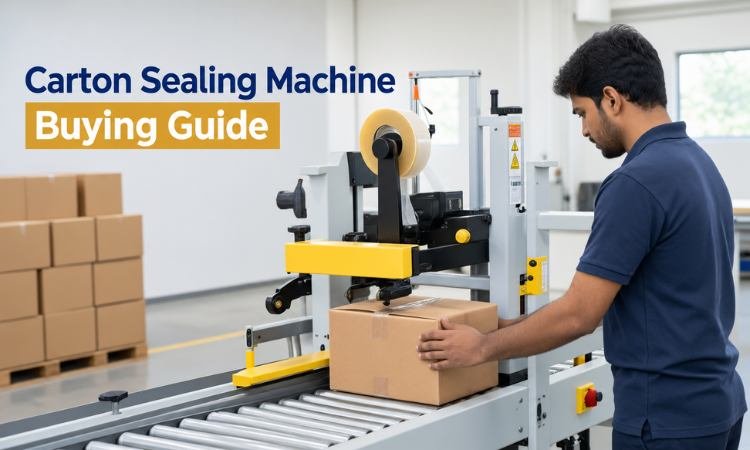
Choosing a carton sealing machine is not simply about finding the lowest price. A machine may look suitable during the purchase process but fail to match your actual production speed, carton sizes, or packaging workflow.
This is especially important when a production line handles different SKUs or needs continuous packaging. The right machine should match your carton volume, size variation, sealing requirements, and level of automation.
In this carton sealing machine buying guide, we explain the main machine types and how to choose one based on your production line rather than only the specifications listed in a brochure. These considerations are relevant for packaging operations across FMCG, e-commerce, pharmaceuticals, food and beverage, and other industries.
What Is a Carton Sealing Machine?
A carton sealing machine automates one of the simplest but most repetitive packaging tasks: closing carton flaps and securing them with adhesive tape. The equipment can be used for small packing operations to continuous production lines, depending on the machine, the cartons can be manually placed or automatically conveyed.
Before comparing models, first define what your line actually requires:
- Output: Number of cartons needed to be produced in an hour or minute.
- Range: Carton Fixed sizes or multiple sizes/SKUs carton range.
- Load: Average carton weight, Maximum carton weight.
- Packaging flow: Stand-alone or integrated with conveyors and other machines.
- Automation: Operator-assisted, semi-automatic or fully automatic.
These details determine the right machine configuration. A high-speed automatic case sealer may be unnecessary for a low-volume line, while a basic fixed-size sealer can become a bottleneck when carton sizes and production volumes change frequently. The right machine is the one that fits the way your line actually work
Types of Carton Sealing Machines Explained
Carton sealers are available in different configurations. The right option depends mainly on production volume, carton consistency, available labour, and the level of automation required.
Semi-Automatic Carton Sealers
A semi-automatic carton sealer requires an operator to place and position the carton before the machine applies the tape.
It can be a practical choice for:
- Small and medium production operations
- Lines with relatively consistent carton sizes
- Businesses moving away from manual taping
- Buyers with a limited automation budget
- Operations where manual carton handling is still required
The main advantage is that it can improve sealing consistency without requiring a fully automated packaging line.
Fully Automatic Case Sealers
A fully automatic case sealer machine is designed for more automated packaging operations. Cartons can move through the machine on a conveyor, reducing the need for manual positioning.
This type is generally suitable for:
- High-volume production
- Continuous packaging lines
- FMCG and manufacturing operations
- Lines already using conveyors and other automated equipment
- Businesses looking to reduce manual carton handling
The machine should be selected according to the actual line speed rather than its maximum advertised speed.
Random Carton Size (Auto-Adjust) Sealers
A random carton size sealer automatically adjusts to different carton dimensions within its specified operating range.
This can be useful when a business packs multiple SKUs or receives orders with different carton sizes. It is particularly relevant for e-commerce and fulfilment operations where carton dimensions can change frequently.
For a carton sealer for ecommerce, check the machine’s minimum and maximum carton dimensions before making a decision. “Random size” does not mean unlimited carton sizes; every machine has a defined working range.
Top & Bottom vs Side-Belt Drive Sealers
The drive configuration also matters.
Top and bottom belt drive machines grip the carton from the top and bottom while it passes through the sealing system. They can be suitable for regular cartons and applications where stable carton handling is required.
Side-belt drive machines grip the carton from both sides. This configuration can be useful for certain taller or heavier cartons, depending on the carton dimensions and machine design.
The correct choice should be based on the carton’s dimensions, weight, shape, and how it behaves while moving through the line.
Match the Machine to Your Production Line
A machine should earn its place on your product line. Rather than choosing by brochure speed or even brand name, then start with three things: how many cartons you seal, how much their sizes vary, and how your industry manages dispatch. Now, this makes it really easier to manage decide whether you need a semi-automatic sealer, an automatic case sealer machine, or a higher-speed setup.
Choose by Daily Carton Volume
Your daily carton count is one of the simplest ways to determine the right level of automation. And, these ranges are practical starting points, not fixed rules:
Daily Carton Volume | Suitable Machine | Why It Fits |
Under 200 cartons/day | Semi-automatic carton sealer | Keeps investment and operator requirements lower while reducing repetitive manual taping. |
200–1,000 cartons/day | Semi-automatic or automatic sealer | Suitable when packing volumes are growing and consistent sealing speed becomes important. |
1,000+ cartons/day | Automatic case sealer machine | Better suited to continuous production, conveyor integration, and high-volume dispatch. |
The actual choice should also consider the number of cartons per minute needed, number of operators, and whether packaging is creating a bottleneck elsewhere in the line. A case sealing machine for high-speed packaging makes sense when the rest of the production flow can support its capacity.
Choose by Carton Size Consistency
For mixed carton sizes, a random carton volume. If you seal one standard carton size throughout the day, a fixed-format semi-automatic machine may provide everything you need. But if different SKUs move through the same line, repeatedly stopping to adjust the machine can reduce the benefits of automation.
For mixed carton sizes, a random carton size sealer with automatic width and height adjustment is generally a more practical option. This is particularly useful for a carton sealer for e-commerce, where order dimensions can change from one shipment to the next.
Choose by Industry Requirement
Additionally, the right sealer relies on the type of packaging operation you’re running:
- Ecommerce: cartons vary in size and SKUs are often changing, which requires automatic adjustment and throughput.
- Packaging manufacturers in the FMCG segment are more interested in continuous operation, conveyor integration, and consistent tape application.
- In pharma: Consistency, handling, hygiene, and traceability are more crucial than just speed maximisation.
- The aim is not to purchase the fastest carton taping machine in India. You choose a system that offers the speed, carton range, automation, and sealing method you need to meet your actual production needs.
The goal is not to buy the fastest carton taping machine in India. It is to choose a system whose speed, carton range, automation, and sealing method match your actual production requirements.
Key Factors to Check Before You Buy
Before buying a carton sealing machine, you should consider these factors as they directly affect your output, seal quality, and downtime:
Sealing Speed & Carton Range
Check the machine’s actual operating speed in cartons per minute or another relevant production measurement.
Also check the complete carton range:
- Minimum carton length
- Maximum carton length
- Minimum carton width
- Maximum carton width
- Minimum carton height
- Maximum carton height
- Maximum carton weight
For example, Dipack’s listed uniform carton sealing machines have specified minimum and maximum pack sizes rather than one unlimited range. Its listed models also support different tape widths and a sealing speed of 20 m/min.
Always compare these numbers with your own cartons.
Tape Type & Seal Quality
The tape used can affect the quality and consistency of the final seal.
Before buying, confirm:
- Compatible tape width
- Suitable tape material
- Tape thickness requirements
- Carton surface compatibility
- Availability of replacement tape
- Quality of the finished seal
BOPP self-adhesive tape is commonly used in carton sealing applications, but the exact tape specification should match the machine and packaging requirements.
A good seal should be properly aligned and firmly attached without unnecessary wrinkles, gaps, or loose edges.
After-Sales Support & Spare Parts Availability
This is particularly important when buying a carton taping machine in India.
A machine can stop an entire packaging process if a critical component fails. Before buying, ask the supplier:
- Is technical support available in your region?
- How quickly can service engineers respond?
- Which spare parts are normally stocked?
- Is preventive maintenance available?
- Is operator training provided?
- What is covered under the warranty?
Dipack states that it provides pan-India technical support and trained engineers for breakdowns and periodic maintenance.
For production equipment, after-sales support should be considered part of the purchase decision rather than an optional extra.
Common Mistakes Indian Buyers Make When Choosing a Carton Sealer
It’s not as simple as picking one that works well on your production floor. These are the mistakes that can turn a seemingly good purchase into an expensive bottleneck:
- Paying for speed you will never use: Pay for what you really and will produce, instead of what you are not.
- Not accounting for carton size variation: When SKUs change often, having a fixed-size machine can become a hassle. For frequently changing carton sizes, try a random size or auto-adjust sealer.
- The cost comparison is not based on the purchase price. When assessing ROI, take into account labour savings, tape used, maintenance, electricity, spare parts, and downtime.
- Treating after-sales service as an afterthought: If your line sits idle for days because of a broken sensor, belt or sealing head and the machine is relatively inexpensive, it’s not much help. Before placing the order, check local technicians, spare availability and service response.
- Not doing an actual production trial: Specifications do not provide data for use with your real cartons and tape. If possible, try out carton size, weight, tape, and carton sealing machine speed before finalizing the carton sealing.
Carton Sealing Machine Cost in India: What Affects the Price
The price of the carton sealing machine in India can vary according to the configuration that your production line needs. These are some of the important factors: level of automation, brand and build quality, carton size range, sealing speed, and conveyor length.
The price of a semi-automatic sealer with a fixed size will vary from that of a high-speed automatic case sealer machine intended to handle variable carton sizes and conveyors. When comparing quotes, consider the specifications, capacity, and features that are included along with the price. See our carton sealing machine price guide for a detailed breakdown.
Conclusion
The right carton sealing machine should match your production volume, carton sizes, required speed, level of automation and service requirements. A semi-automatic machine may be enough for a smaller operation, while high-volume or mixed-carton lines may benefit from automatic or random-size systems.
If you’re comparing carton sealing machines for your production line, start with your actual carton dimensions and daily volume rather than choosing only by price or advertised speed.
Not sure which type fits your line? Get a free consultation from Dipack’s packaging engineers and discuss your carton size, production volume and automation requirements.