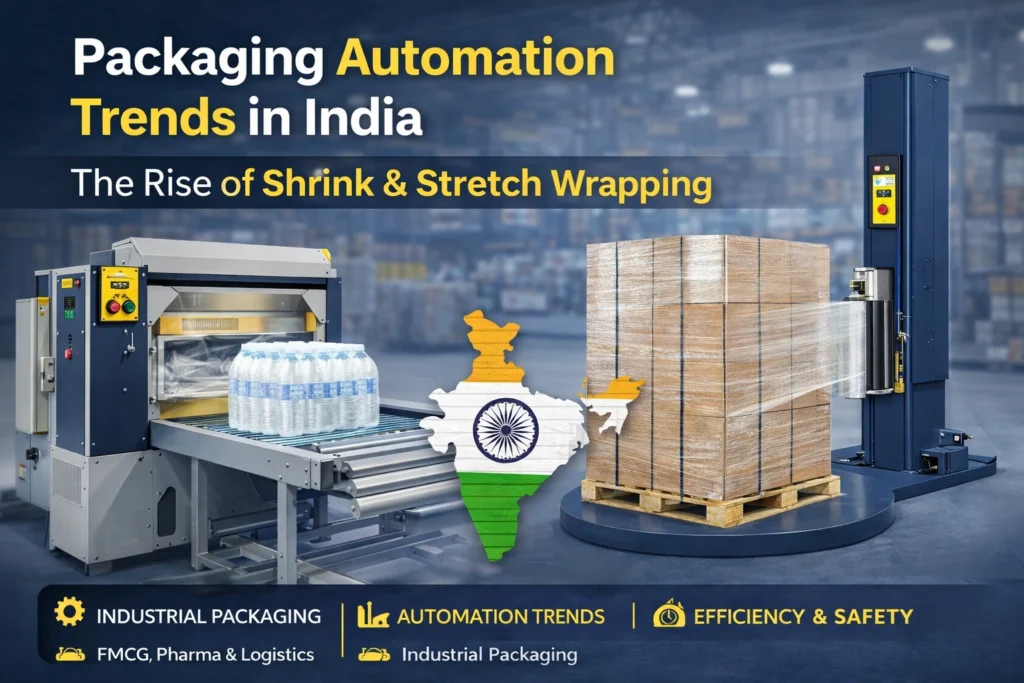
E-commerce and manufacturing are booming at a high rate in India. This was never seen before in this country. The online sales have jumped by around 34% in just the last year, and factories are operating at maximum capacity to churn out goods and deliver them to the customers fast. But one challenge still remains unsolved: the challenge of packaging goods, and that too in a cheaper, reliable, and faster way. This is the new move towards packaging automation in India, where the goods move from the production line to the doorsteps of the consumer fast and in a reliable way.
The modern revolution in quick and efficient industrial packaging solutions has been taken by stretch and shrink wrapping machines, and these machines have become an important tool for Indian industries. These systems are not just designed for fast packaging; they ensure that product is packaged safely, cut packaging costs, and reduce waste in packaging as well, and thus the product gets delivered intact. As the customer expectations are growing and costs of labor rising, understanding these technologies is not just an option—this is business survival.
What is Packaging Automation?
Packaging automation directly means that you are using machines and software towards handling packaging that was previously done by hand. This covers everything, from filling containers to sealing boxes, along with wrapping pallets as well. For all the Indian manufacturers, this level of technology gain can provide multiple benefits towards packaging automation in India:
- Speed: Automatic systems can easily work 24X7 without taking breaks and processing hundreds of units each hour.
- Accuracy: No more inconsistent wrapping or misaligned seals—each packaging can meet quality standards.
- Labor Reduction: For the skilled workers that are in short supply, automation can fill the gap while reducing any kind of payroll costs by up to 40%.
Types of Automated Packaging Machines
While multiple packaging machines are there, four stand out for Indian businesses:
- Shrink Wrap Machine
The shrink wrap machine system uses heat to tightly tighten the plastic film at the bottom of your machine, thus creating the shiny and professional finish you might see on multipacks of cosmetics or beverages.
- Stretch wrapping machines in India
The system of stretch wrapping machines does specialize towards securing palletized goods for the elastic film. This is great for warehouses that are shipping goods across the country.
- Carton Packaging Machines
The carton packaging machines in an automatic manner form, fill, and also seal cardboard boxes at speeds that are impossible for manual workers.
- Case Sealers
The case sealers provide for tamper-evident and consistent closures that can be used for everything from foods to pharmaceuticals.
Growth of Packaging Automation in India
Market Drivers
Three forces are accelerating adoption:
- E-commerce explosion: With e-commerce platforms like Flipkart, Myntra, and Meesho processing millions of orders every day, automated packaging thus ensures that fragile items survive India’s delivery routes.
- Pharma & FMCG Growth: Brands like Cipla, Mankind, Dabur, or Patanjali need constant and sterile packaging for protecting product integrity and meeting regulatory standards.
- Make in India Push: Government schemes encourage factories towards modernization and packaging automation, going high into the modernization lists.
Benefits for Indian Manufacturers
Local businesses thus report a greater level of improvements when automation is applied:
- Labor Costs Down by 35%
One stretch wrapping machine can replace around three manual wrappers.
- Production cycles 50% faster
Shrink-wrapping machines can handle up to 120 packs per minute versus 30 for manual labor.
- Quality Consistency
With the quality consistency, no more weak spots that cause 20% of the transit damage claims.
For all the Indian manufacturers that are competing on a global level, these gains create a difference between loss and profit.
Shrink Wrapping Machines in Packaging Automation
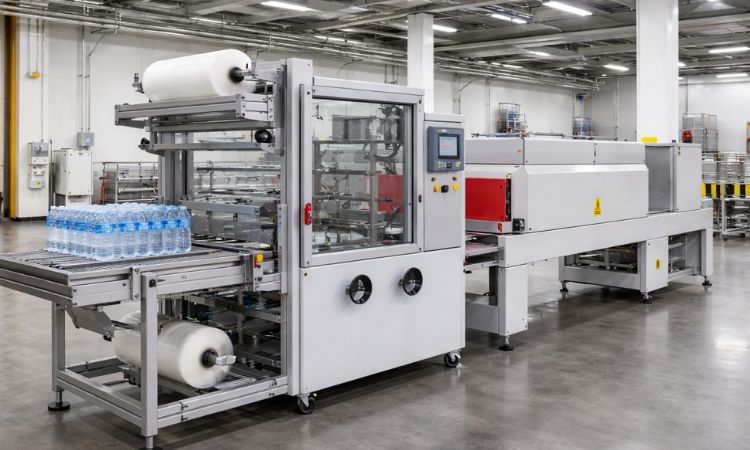
Shrink wrapping involves wrapping products in loose plastic film, then applying heat to shrink it tightly around them. In India, these shrink-wrapping machine systems are revolutionizing how brands can present their products.
FMCG giants use them for pharma companies, beverage multipacks, and small e-commerce companies’ sellers for premium unboxing experiences. For visual appeal matters, shrink-wrapped products account for 18% of the shelf sales in industry reports.
Benefits of Shrink Wrapping Automation
Automated shrink wrapping can deliver the three major advantages:
- Cost Savings: Machines that use around 30% can lessen the need for manual methods while wrapping these twice as fast.
- Product Protection: Seals that are tamper-evident can prevent contamination and theft—important for medicine and food.
- Consistent Quality: Each package looks professional, thus building trust for the consumers.
Popular Applications in India
These sectors have led the shrink-wrapping adoption:
- FMCG: Beverage companies can easily bundle bottles together for retail displays.
- Pharmaceuticals: Sterile packaging can protect medicines from tampering or moisture.
- E-commerce: Sellers can use mini-shrink systems for the creation of premium unboxing experiences for those high-value items.
Stretch Wrapping Machines in Packaging Automation
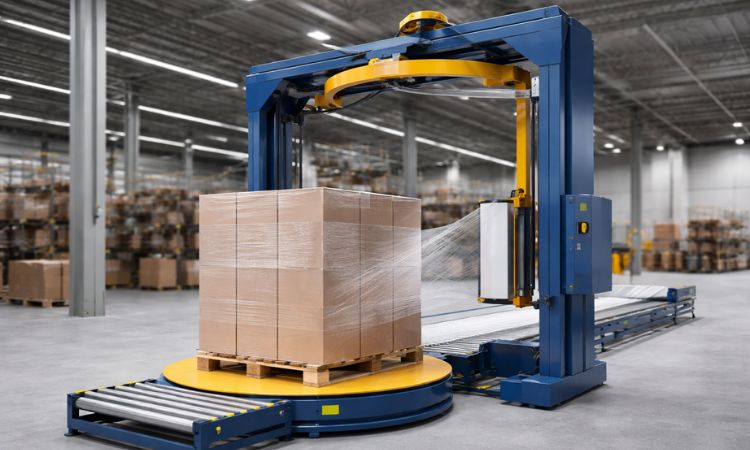
These stretch wrapping machines systems for securing pallets using elastic pallets for any heat. A turntable or the rotating arm can apply tension with controlled wrapping and automatic adjustment of film per load per size, slashing the material costs for ensuring 40% of the transit-safe packaging for e-commerce and warehouse fulfillment centers.
Industries Using Stretch Wrapping in India
Three sectors use this packaging automation in India:
- Warehousing & logistics: Each major 3PL provider can use stretch wrappers for securing goods for nationwide transport.
- Food & Beverage: Companies do use wrap pallets for canned goods or bottled water to prevent shifts due to monsoon shopping and shipping.
- Manufacturing & Export: Factories are preparing goods that will be transported across the globe and use stretch wrapping machines for securing goods for transit damage.
Emerging Trends in Packaging Automation
For innovations and reshaping the landscape:
- Smart Machines: These are IoT-enabled systems that can predict maintenance needs and further optimize film usage.
- Sustainable Solutions: Recyclable films and energy-efficient motors can help brands meet ESG goals.
- Customized Automation: Any type of modular design can adapt for varied product sizes without any kind of costly retooling.
How to Choose the Best Industrial Packaging Solutions
Selection of the best systems requires some consideration:
- Production volume: High-volume operations require completely automatic solutions.
- Product characteristics: Fragile items thus require gentler and safer handling than industrial parts.
- Budget & ROI: Most of the systems pay for themselves in the timespan of 8 to 14 months through materials and labor savings.
- Local Support: Choose suppliers with service centers nearby or pan-India support for avoiding any kind of costly downtime.
Conclusion
Packaging automation is not just a luxury anymore but a necessity of these modern times—these machines are now the lifelines of packaging, where the industries and warehouses have to meet strong customer expectations and fast delivery deadlines. These are the modern packaging automation Indianeeds in this day and age, and they do come with multiple benefits like speed and cost savings and all-round better packaging. By advancing in your packaging process, you are not only protecting products, you are actually future-proofing the entire business.
FAQs About Packaging Automation India
Q: What’s the starting price for a shrink wrap machine in India?
The basic prices of semi-automatic machines start from around ₹2.5 Lakhs, and fully automatic machines range from ₹6 Lakhs, although it depends on features and machine variants.
Q: How much can I save using automated packaging?
Most businesses can save around 30% to 40% of the costs in packaging, which includes labor, packaging material, and a faster packaging process. The ROI is achieved in around 10 months after installation.
Q: Which industries benefit most from packaging automation?
E-commerce, FMCG, food processing, and pharma can easily benefit from the advanced packaging machines.
Q: Can shrink & stretch machines handle India’s diverse product sizes?
Yes, modern and advanced systems can handle everything from large industrial pallets to e-commerce parcels and more.
Q: Do these machines work with eco-friendly films?
Yes, in fact, these machines are designed to work with multiple material types and can further work with biodegradable industrial packaging solutions without any kind of performance loss.