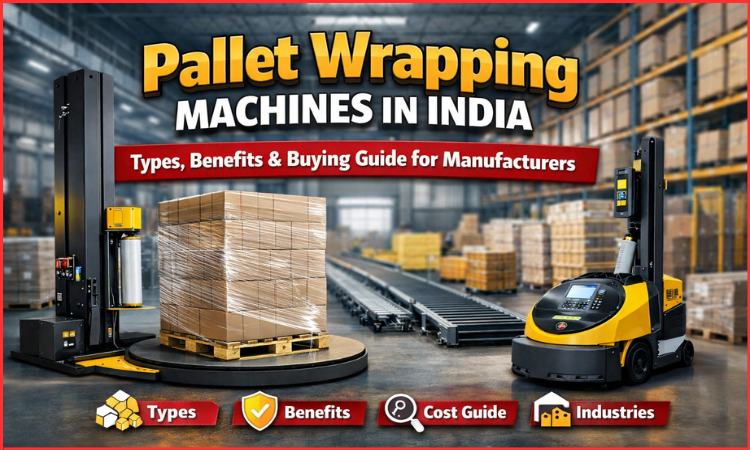
In today’s fast-moving Indian manufacturing and logistics environment, safe and efficient pallet packaging is no longer optional. With increasing dispatch volumes, rising labour costs, and strict delivery commitments, manufacturers need reliable pallet packaging solutions.
A pallet wrapping machine ensures that palletized goods remain stable, protected, and professional-looking during storage and transportation. From FMCG and pharma to exports and e-commerce, pallet wrapping machines have become an essential part of modern secondary packaging operations in India.
What is a Pallet Wrapping Machine?
A pallet wrapping machine is a packaging machine that wraps stretch film tightly around products stacked on a pallet. This wrapping keeps the load secure, prevents movement, and protects goods from dust, moisture, and damage during handling and transport.
How a Pallet Wrapping Machine Works
The pallet is placed on the machine (turntable or floor position).
Stretch film is attached to the pallet load.
The machine rotates the pallet or wrapping arm.
Film is stretched and wrapped evenly around the load.
Multiple layers are applied for stability.
Film is cut automatically or manually (based on machine type).
The wrapped pallet is ready for dispatch or storage.
Manual Pallet Wrapping vs Pallet Wrapping Machine
Industries Using Pallet Wrapping Machines in India
FMCG Industry
Used to secure large volumes of packaged goods, liquids, and household products while ensuring fast dispatch cycles.
Pharmaceutical Industry
Ensures clean, stable, and contamination-free packaging for long-distance transport and export compliance.
Food & Beverage Industry
Provides hygienic and moisture-resistant pallet packaging, especially for export shipments.
E-commerce & Retail Warehousing
Improves speed and safety while handling high order volumes and mixed pallet loads.
Exporters & Logistics Companies
Helps meet international shipping regulations and prevents transit damage during domestic and global transport.
Healthcare & Industrial Units
Used for wrapping heavy machinery parts and raw materials to ensure safe handling and storage.
Types of Pallet Wrapping Machines in India
Manual Pallet Wrapping (Traditional Method)
How Manual Wrapping is Done
Workers manually wrap stretch film around the pallet by walking around it and pulling the film by hand.
Limitations
High labour dependency
Uneven and inconsistent wrapping
Excessive film wastage
Why Manufacturers Are Shifting Away
Manual wrapping increases operational cost, reduces consistency, and cannot handle growing dispatch volumes efficiently.
Semi-Automatic Pallet Wrapping Machines
What is a Semi-Automatic Pallet Wrapper?
A semi-automatic pallet wrapping machine uses a motorized turntable or arm to wrap pallets, while the operator loads and unloads the pallet.
How It Works
Operator places pallet on the turntable
Film is attached manually
Machine performs automatic wrapping cycles
Key Features
Turntable system
Adjustable tension control
Consistent and repeatable wrapping
Best Suited For
Small to mid-scale manufacturers
Low to medium pallet volumes
Fully Automatic Pallet Wrapping Machines
What Makes It Fully Automatic?
Fully automatic machines require no manual intervention and work seamlessly with automated production lines.
Key Capabilities
Integration with conveyor systems
Automatic film cutting and clamping
Minimal human involvement
Ideal For
High-volume production units
Large warehouses
Export-oriented companies
Rotary Arm Pallet Wrapping Machines
When to Use
Lightweight or unstable loads
Tall pallets that cannot rotate
Advantages Over Turntable Machines
Pallet remains stationary
Safer for fragile loads
Faster wrapping cycles
Preferred Industries
Pharma
FMCG
Chemical and electronics manufacturers
Mobile / Robot Pallet Wrapping Machines
What is a Robotic Pallet Wrapper?
A mobile pallet wrapping robot moves around the pallet and wraps it without fixed installation.
Benefits
High flexibility
Space-saving design
Suitable for large or irregular pallet sizes
Best Applications
Large warehouses
Multiple wrapping locations
Limited floor space facilities
Benefits of Using Pallet Wrapping Machines for Indian Manufacturers
Improved Load Stability & Safety
Prevents load shifting during transport
Reduces damage and customer complaints
Reduced Packaging Cost
Optimal stretch film usage
Less film wastage
Long-term cost savings
Higher Productivity & Faster Dispatch
Faster wrapping cycles
Smooth warehouse operations
Lower Labour Dependency
Reduced manpower requirement
No skilled labour needed
Professional & Export-Ready Packaging
Clean and uniform wrapping
Meets export packaging standards
Manual Wrapping vs Pallet Wrapping Machine : Comparison Table
Factor | Manual Wrapping | Pallet Wrapping Machine |
Speed | Slow | Fast |
Film Usage | High wastage | Optimized |
Labor | High | Low |
Consistency | Uneven | Uniform |
Cost per Pallet | High | Lower |
Industries That Should Invest in Pallet Wrapping Machines
Manufacturing plants
Warehouses & 3PL companies
Pharmaceutical companies
FMCG & food processing units
Exporters & logistics hubs in Delhi NCR
How to Choose the Right Pallet Wrapping Machine in India
Factors to Consider
Daily pallet volume
Load size and weight
Available warehouse space
Type of stretch film
Budget and ROI expectations
Common Mistakes to Avoid While Buying
Choosing a machine only based on price
Ignoring after-sales service support
Not checking film compatibility
Underestimating future production growth
Maintenance Tips for Long Machine Life
Regular cleaning
Film carriage inspection
Proper operator training
Scheduled servicing
Conclusion: Is a Pallet Wrapping Machine Worth the Investment?
For Indian manufacturers, investing in a pallet wrapping machine delivers clear benefits—lower packaging costs, faster dispatch, reduced labour dependency, and professional packaging quality.
With India’s manufacturing and export sector growing rapidly, automated pallet packaging is not just an upgrade but a necessity. From ROI improvement to future-ready operations, pallet wrapping machines are a smart investment for businesses aiming to scale efficiently.