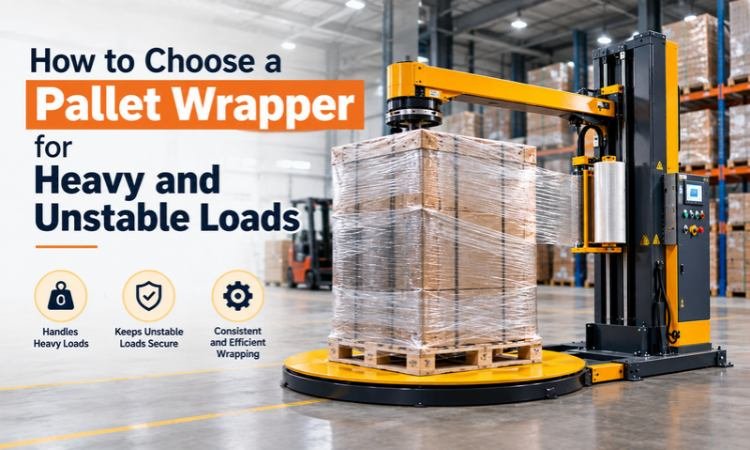
When you’re shipping goods, unstable and heavy palettes that can shift, topple, or lean that have become damaged for transportation and handling. This actually creates a highly massive risk for the product loss plus workplace injuries. Choosing the right type of equipment is not about finding the machine that has the maximum load weight. For actually securing the shipments, the buyers need to consider the load dimensions, film tension, weight distribution, wrapping patterns, and pre-stretch capabilities for the overall machine configuration. In this blog, we will learn exactly how you can exactly evaluate the needs for selecting the perfect pallet wrapper for heavy and unstable loads for keeping the products safe and the operations efficient.
Why Heavy and Unstable Loads Need the Right Pallet Wrapper
The difficult loads thus require the highly controlled wrapping for uniform, standard pallets. When dealing with the heavy pallet loads or the unstable pallet loads, the real goal is actual containment, not just about wrapping the pallet that is tightly possible.
Certain factors can make the loads challenging:
- Narrow or tall loads: These are the high center of gravity that can be prone to swinging.
- Uneven weight distribution: The top-heavy items that will tip over quickly.
- Irregular-shaped products: Machinery, pipes, or those odd boxes that can create gaps where films can snap.
- Heavy components and cartons: These do require immense holding force to stop it from shifting.
- Forklift handling risks: Sudden turns or stops that can easily dodge for that poorly secured pallet.
Achieving the proper pallet stability means those films can hold the load together for the single and sold unit. The right pallet packaging strategy can ensure that the load will survive the sudden stops, rough roads, or longer-distance transits without any kind of collapse.
What to Check Before Choosing a Pallet Wrapper
Before you look for those specific machines, evaluate the real packaging environment towards the practical checklist:
Load Weight
The max pallet weight will dictate the machine’s capacity for the strength of its turntable or the support structure. Do account for the weight variations.
Load Dimensions
Measuring the exact length and width along with the height of the pallets. The oversized loads require the specialized machines for extended carriages of the open-side designs.
Load Shape and Stability
Narrow, tall, and irregular or those loosely tacked products that can be standard boxes. These require the specific wrapping approaches, like the reinforced top plus the bottom wraps, for maintaining integrity.
Daily Pallet Volume
If you are wrapping those hundred pallets a day, the higher throughput can justify the investment for fully automated systems for those quicker wrapping cycles.
Available Floor Space
Consider that machine footprint. You require enough room towards the forklifts for approaching, loading, and unloading the pallets without hitting the walls or those other pieces of equipment.
Which Pallet Wrapper Is Best for Heavy and Unstable Loads?
Not all those machines are created equally. Here’s the basic comparison for helping you decide the type of configuration that fits your needs:
Wrapper Typex | Suitable For | Important Consideration |
Turntable Wrapper | General applications and stable loads | The load needs to be positioned perfectly; rotating for the top-heavy loads can be risky. |
Rotary Arm Wrapper | Heavy and tall loads for less-stable loads. | The load will stay stationary while the arm will rotate around that, preventing tips |
Robot Wrapper | Variable locations or those changing load sizes. | Flexible, this requires unobstructed, stable operating space. |
Automatic Wrapper | High-volume and repetitive operations | Great towards consistent & hands-free wrapping towards conveyor line. |
Semi-Automatic Wrapper | Medium-volume for operations | Requiring the operator for attaching the film & starting the cycle. |
For those truly difficult shipments, a pallet wrapper for heavy loads for the rotary arm configuration is often the great choice. As the pallet never moves or spins, there’s zero risk for load shifting or toppling for the wrapping process.
Key Pallet Wrapper Features for Heavy Loads
When comparing machines, don’t look only at price. Pay attention to the features that directly affect load containment and wrapping consistency.
1. Suitable Load Capacity
The machine must safely handle the weight of your pallets.
Check the maximum rated load and compare it with your heaviest pallet, rather than choosing based on average weight.
2. Adjustable Film Tension
Film tension determines how tightly the film is applied around the load.
Controlled tension can help improve load containment while reducing the risk of crushing cartons or damaging sensitive products.
3. Pre-Stretch Control
Pre-stretch allows the film to be stretched before it is applied to the pallet.
The correct pre-stretch setting can help improve film efficiency and create more consistent wrapping. The appropriate setting depends on the film and the application.
4. Adjustable Wrapping Speed
Different loads may require different wrapping speeds.
Having adjustable speed allows the operator to use a suitable cycle for the load instead of treating every pallet in exactly the same way.
5. Adjustable Wrapping Patterns
Some loads need additional wrapping around the top or bottom sections.
A machine with programmable or adjustable wrapping cycles can provide greater control for different pallet configurations.
6. Appropriate Machine Configuration
The arm, turntable, mast, and other machine components should match your pallet dimensions and load characteristics.
For heavy or unstable loads, keeping the pallet stationary during wrapping may be an important consideration.
7. Safety Features
Safety should be considered from the beginning.
Look for appropriate guarding, emergency-stop systems, operator controls, and other safety features required for the machine and workplace.
How Film Selection Affects Heavy and Unstable Loads
Film selection and machine selection should go hand in hand. Using the wrong pallet wrapping film can ruin everything, even the best of the best machines.
Take in these factors:
- Film characteristics and film thickness: Higher stretch films provide better holding force, and thicker films provide a higher level of puncture resistance.
- Pre-Stretch Compatibility: Ensuring that machine stretch film is designed for stretch (often around 250%) without breaking.
- Holding Force: This is actually the film’s memory or the right kind of desire that provides the actual load containment.
Important distinction: Application of more of the layers just does not mean a basic, more secure pallet. The correct film tension or proper pre-stretch film usage and that smart wrapping pattern are much more important than just wasting that material.
How to Prevent Pallet Loads from Shifting During Transport
Wrapping is just a part of the equation. For complete movement, just follow the practical steps:
- Stable Pallet Stacking: Interlock boxes like the bricks for the creation of unified, solid columns.
- Adequate bottom wraps: Always apply those 3 to 5 wraps around the base for locking in the load for the wooden pallet.
- Proper Overlap: Maintaining a 50% overlap for the spiral wrap towards continuous coverage.
- Reinforced Wrapping: Adding in extra wraps for the sharp corners or weak areas.
- Correct bottom/top setting: Ensuring that the machine gets programmed for securing both the bottom and top easily.
Just remember, a load that’s not properly stacked, or an unsuitable or broken pallet, can cause movement no matter how well that gets wrapped:
How to Choose a Pallet Wrapper Based on Load Type
Using the mini decision table for matching in that specific product for the right machine features:
Load Type | What to Look For |
Heavy components/machinery | Higher load capacity & higher controlled film tension. |
Tall loads | Suitable wrapping/arm height & stationary wrapping (rotary arm). |
Irregular loads | Adjusted wrapping patterns & gentle tension control. |
Loose cartons | Robust load containment & higher-holding-force film. |
Long/oversized loads | Appropriate machine dimensions (e.g., open-side or robot). |
Frequently changing loads | Flexible settings or the programmable memory cycles. |
Common Mistakes When Buying a Pallet Wrapper
Avoid any kind of costly errors when going for pallet wrapper for heavy and unstable loads:
- Choosing a machine based just on upfront price.
- Ignoring those actual maximum pallet dimensions or weight.
- Using low-quality, unsuitable film that breaks under tension.
- Ignoring that inherent load stability issues (fixing the stacking initially).
- Buying a machine for insufficient capacity towards future growth.
- Failing towards checking the supplier service, spare parts, and maintenance.
Pallet Wrapper Selection Checklist
Simply save this basic checklist when you speak with a packing supplier:
- Minimum and maximum pallet dimension (LXW)
- Maximum pallet weight (KG)
- Max Load Weight
- Daily pallet quantity needed.
- Load shape + stability profile.
- Preferred film thickness and type
- Required pattern for wrapping (for instance, bottom/top wraps)
- Required pre-stretch percentage.
- Available forklift access and floor space.
- Machine power requirements (three-phase vs. single-phase)
- Safety feature requirements
- Support availability and supplier service
Conclusion
Securing those technical shipments should not have to be a basic guessing game. For understanding the load’s unique characteristics and prioritizing the true load containment for simple tightness, that can prevent any kind of costly damage plus workplace accidents. Whether you need a stationary-arm system or that high-speed automatic line, just choosing the right pallet wrapper for heavy loads is an investment for your brand’s reliability. Do evaluate the needs from the checklist above, and do consult the packaging experts for finding a solution that can deliver safety, long-term savings, and efficiency.
Frequently Asked Questions
What type of pallet wrapper is best for heavy and unstable loads?
The right pallet wrapper depends on the load weight, dimensions, shape, stability, and wrapping requirements. Turntable wrappers can work well for stable pallets, while rotary arm wrappers can be useful for heavy or unstable loads that should remain stationary during wrapping. High-volume operations may also benefit from automatic or robotic wrapping systems.
Is a rotary arm wrapper suitable for unstable pallets?
Yes, a rotary arm pallet wrapper can be suitable for certain unstable pallets because the load remains stationary while the wrapping arm moves around it. This can help avoid rotating a heavy or unstable pallet on a turntable. The final selection should consider pallet weight, load dimensions, height, film requirements, and available operating space.
How do I wrap a heavy pallet without damaging the load?
Use stretch film with suitable strength and stretch characteristics, then adjust film tension according to the product and load stability. Excessive tension can damage cartons or sensitive products, while insufficient tension may provide poor containment. Appropriate wrapping speed, film overlap, and top and bottom wrap settings also help create secure containment without unnecessary compression.
What type of stretch film is used for heavy pallets?
Stretch film for heavy pallets should be selected according to load weight, shape, stability, containment requirements, and machine compatibility. Film thickness, stretch capability, holding force, and pre-stretch performance should all be considered. A heavier film is not automatically better; the goal is to achieve reliable load containment with the appropriate film and wrapping settings.