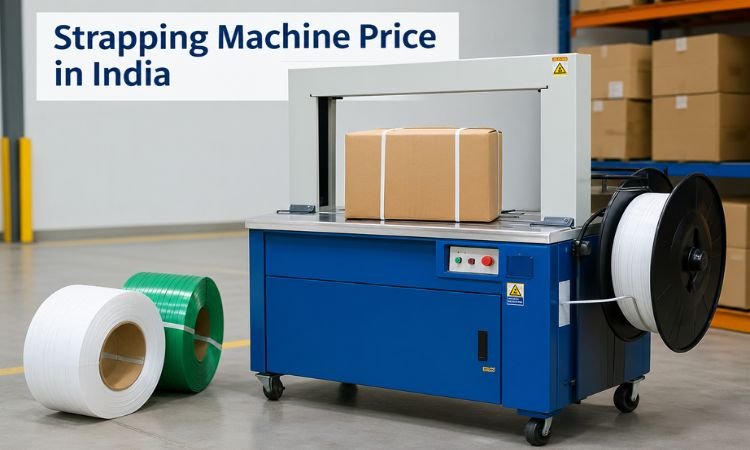
Most of the buyers compare only the basic sticker price and end up overpaying for consumables or that costly downtime. The basic reality is that a strapping machine price in India varies widely, from the ₹30,000 of these basic tools for over ₹4 Lakh towards advanced automated systems. The wider range depends fully on automation levels, material compatibility, and build quality. This guide will break down what exactly drives that cost, helping you to budget perfectly and avoid any kind of hidden expenses, plus choose a machine that can deliver a higher and longer-term value.
Strapping Machine Price in India – Quick Overview
If you’re in a hurry, here is a basic snapshot of what you can expect. The box strapping machine cost generally increases with the level of automation and production capacity required.
Machine Types | Basic Price Range (INR) | Suited For |
Manual Strapping Tools | ₹15,000 to ₹35,000 | Occasional use, very low volume, tight budgets. |
Semi-Automatic Machines | ₹45,000 to ₹1,20,000 | Smaller to medium businesses (50–150 boxes/day). |
Fully Automatic Machines | ₹1,50,000 to ₹4,00,000+ | Higher-volume FMCG, export lines and e-commerce. |
Note: This is the general strapping machine price list estimation. The exact quotes depend on specific strap width, customization needs, and speed requirements.
What Is a Strapping Machine?
A strapping machine is packaging equipment used to secure cartons, boxes, bundles, pallets, and other suitable loads with plastic strapping.
Depending on the machine, the process can include:
- Strap feeding
- Strap positioning
- Tensioning
- Sealing
- Cutting
- Resetting for the next cycle
Manual tools require considerably more operator involvement, while automatic systems can perform most or all of the strapping cycle with minimal intervention.
Strapping machines are commonly used in manufacturing, FMCG, e-commerce, logistics, warehouses, automotive, and other industries where packaged goods need to remain secure during storage and transportation.
Types of Strapping Machines and Their Costs
1. Manual Strapping Tools
Manual or portable strapping tools are generally suitable for businesses with limited packaging volumes.
They have a relatively low initial investment and can be useful when products have irregular sizes or when strapping is not required continuously throughout the day.
However, manual tools require more operator involvement and may not be suitable for businesses handling hundreds of packages every day.
Indicative price: ₹15,000–₹35,000
2. Semi-Automatic Strapping Machines
Semi-automatic machines offer a balance between affordability and productivity. The operator usually positions the package and starts the strapping cycle, while the machine performs functions such as tensioning and sealing.
These machines are suitable for warehouses, manufacturing units, distributors, and other businesses with moderate packaging volumes.
DIPACK lists semi-automatic models with features such as adjustable tension and strap compatibility in the 6–15 mm range, depending on the model.
Indicative price: ₹45,000–₹1,20,000
3. Fully Automatic Strapping Machines
Fully automatic machines are designed for businesses that need faster and more consistent packaging with less manual intervention.
Depending on the configuration, these machines can automatically detect or position packages and perform strap feeding, tensioning, sealing, cutting, and resetting.
They can also be integrated with conveyor-based packaging lines, making them suitable for continuous operations.
Indicative price: ₹1,50,000–₹4,00,000 or more
The exact cost depends on the machine configuration, speed, package dimensions, automation requirements, and integration with the existing production line.
What Determines Strapping Machine Price?
The price is not random; several factors influence it. Understanding these factors can help you evaluate quotes more effectively.
Automation Level (Manual vs. Semi-Automatic vs. Fully Automatic)
The automation level is one of the biggest price factors. A manual machine is cheaper but also slower. A basic semi-automatic machine adds motorized tensioning and sealing, generally increasing the cost compared with a manual setup.
A fully automatic setup that can integrate with a conveyor and operate with minimal operator intervention can cost around three to four times more than a semi-automatic model. When evaluating the automatic strapping machine price, remember that the higher cost can also provide labor savings and more consistent operation.
Strap Material Compatibility (PP vs. PET)
Not all machines can handle every type of strap. PP (polypropylene) strapping is a standard and lightweight option. Machines designed to handle high-tension PET straps require stronger sealers, heavy-duty motors, and reinforced frames.
These additional components can increase the machine’s baseline price when moving from basic PP compatibility to PET compatibility.
Strapping Speed & Production Capacity
Speed can also affect the price. A machine that straps around 10 boxes per minute can use standard components, while a machine designed for 40+ boxes per minute requires servo motors, high-speed sealing systems, and advanced PLC controllers.
High-volume buyers may find this investment useful for preventing bottlenecks and maintaining consistent production.
Build Quality & Machine Life
A machine that is mild steel and thin, and the generic local motors that will be cheaper upfront but can fail early or warp material within a year. Matchings that feature stainless steel frames, imported European or Japanese motors, and the industrial-grade circuit boards that can initially last around 5 to 10 years for those minimal issues.
After-Sales Service & Warranty Coverage
This is generally ignored but can add that real-cost difference for suppliers. A basic, no-name supplier can provide a low price but that zero support. Reputable and trusted brands like DIPACK provide all-comprehensive warranties and complete pan-India service networks.
Hidden Costs Buyers Often Miss (Total Cost of Ownership)
Smart buyers look beyond the initial product price. The total cost of ownership can include:
Consumable Costs: Cheaper machines may waste strap material because of inconsistent tension, increasing monthly strap roll costs.
Installation and Training: Some suppliers charge separately for setup and training. DIPACK provides installation support and operator training to help ensure the machine is set up and used correctly from day one.
Downtime Costs: A ₹40,000 machine that breaks down regularly and halts the dispatch line can ultimately cost more than investing in an ₹80,000 machine with better reliability.
Semi-Automatic vs. Fully Automatic—Which Fits Your Budget?
Use this simple framework to decide which option fits your requirements.
Choose Semi-Automatic If:
You operate a small warehouse or MSME strapping around 150 boxes per day. A semi-automatic machine offers a balance between productivity and affordability. It generally requires one operator to place the strap and activate the machine.
Choose Fully Automatic If:
You operate a high-speed FMCG line, heavy manufacturing unit, or large e-commerce fulfillment center that handles 200+ boxes per day. The higher upfront cost can be offset by reduced manual labor and more consistent throughput.
How to Get an Accurate Price Quote (Avoid Overpaying)
To get a precise quote without paying for features you do not need, prepare the following checklist before contacting your supplier:
Strap Specifications: Required strap width, such as 16 mm, 12 mm, or 9 mm, along with the material (PET or PP).
Daily Volume: Average number of pallets or boxes strapped per shift.
Power Supply: Whether the facility has single-phase or three-phase electricity.
Space Constraints: Available floor dimensions and whether conveyor integration is required.
Warranty Coverage: Clarify what is covered, such as PLCs, motors, and sealers, and for how long.
Share these specific requirements with the DIPACK team to receive an accurate quote tailored to your factory’s needs.
Conclusion
When evaluating packaging equipment, the price should always be judged based on total value, not just the upfront sticker cost. Investing in the right type of machine can reduce consumable waste, prevent costly downtime, and help ensure that products reach customers safely.
At DIPACK, we do not just sell machinery; we build long-term relationships backed by pan-India service, expert operator training, and technology designed specifically for Indian conditions.
Whether you are scaling a small warehouse or optimizing a high-speed FMCG production line, the right strapping solution can help deliver material and labor savings over time.
Ready to streamline your packaging process and maximize your packaging ROI? Contact DIPACK today for a free consultation and the right quote for your business.
FAQs
What is the average price of a strapping machine in India?
Prices can range from around ₹30,000 for basic models to approximately ₹3 lakh to ₹4 lakh for fully automatic and conveyor-integrated systems. The exact price depends on factors such as build quality, speed, automation, and machine specifications.
Is a semi-automatic or fully automatic strapping machine better for small businesses?
Semi-automatic machines are generally suitable for small businesses because they are affordable, easy to operate, and faster than manual tools without the higher cost of full automation.
Does strap material affect machine price?
Yes. Machines designed for heavy-duty PET straps require stronger motors and reinforced sealing components, which can make them more expensive than machines designed for PP straps.
What is the monthly running cost of a strapping machine?
Running costs are generally low and mainly consist of strap rolls and electricity. The overall cost can be lower than the ongoing labor costs associated with manual strapping.