
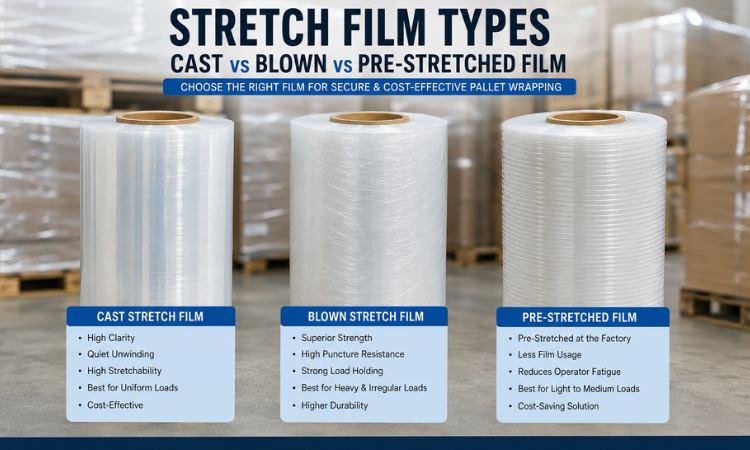
A pallet wrapped for the wrong stretch films can lead to unstable loads, torn edges, and damaged products when transporting. Most warehouse managers can focus entirely on getting the best wrapping machines, thus focusing on the best wrapping machines, just to load these machines with the wrong type of material. Choosing the right type of film is just as important as the main equipment itself. But with the stretch film types for the market, why do so many of the businesses end up choosing the not right one? Often, this is simply a lack of clear and practical information. For this complete industrial guide, we will be breaking down exactly the different types of films that exist and practical information. For the full guide, we will be breaking down exactly the different films that exist, comparing the cast for the pre-stretched films, and helping in deciding which one saves the business money and time as well.
What Is Stretch Film and Why Does the Type Matter?
Stretch film is a highly stretchable plastic film used to secure products tightly on pallets during storage and transportation. It keeps boxes and other items firmly together by using the film’s elastic memory, which creates consistent tension around the load.
The performance of stretch film depends largely on the type you choose.
The right stretch film can:
- Keep pallet loads stable during transportation.
- Protect products from dust, moisture, and dirt.
- Reduce the risk of tampering.
- Minimize product damage and packaging costs.
- Improve warehouse efficiency.
Whether you use machine stretch film for automated pallet wrappers or hand stretch film for manual wrapping operations, selecting the right film directly affects packaging quality, speed, and overall operating costs.
Different Types of Stretch Film at a Glance
Here’s the right comparison for helping in understanding the main differences before we go deep:
Film Type | Manufacturing Process | Tear Resistance | Stretch Capacity | Noise Level | Transparency | Best Applications | Cost | |
Cast | Cast extrusion (chill rolls) | Moderate | High (250%+) | Very Quiet | High (Clear) | Uniform, light loads | Lower | |
Blown | Blown extrusion (air bubble) | Very High | Moderate (150%+) | Loud | Low (Hazy) | Heavy, irregular loads | Higher | |
Pre-Stretched | Stretched before rolling | Low to Moderate | Low (already stretched) | Quiet | High | Manual wrapping, light loads | Moderate |
Cast Stretch Film: Features, Advantages, and Best Uses
How Cast Stretch Film Is Manufactured
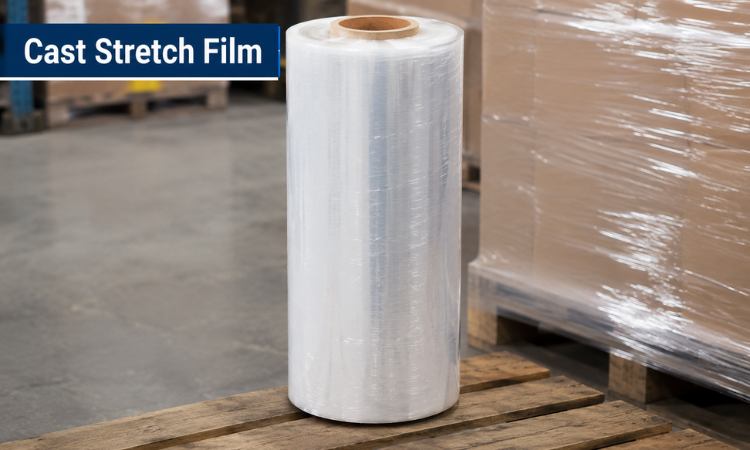
Cast stretch film is produced by melting plastic resin and extruding it through a flat die onto chilled rollers. The rapid cooling process gives the film a smooth finish, excellent clarity, and consistent thickness throughout the roll.
This manufacturing process makes cast stretch film one of the most widely used packaging materials for standard pallet wrapping applications.
Key Features of Cast Stretch Film
- High clarity for easy barcode and label scanning.
- Glossy appearance that improves product presentation.
- Quiet and smooth unwinding during application.
- Consistent film thickness across the entire roll.
- Excellent two-sided cling for secure pallet wrapping.
Advantages of Cast Stretch Film
Cast stretch film offers several advantages for businesses handling standard pallet loads.
- Lower production cost compared to blown stretch film.
- Easy to stretch during both manual and machine wrapping.
- Requires less effort for operators during hand wrapping.
- Excellent clarity for warehouse identification and inventory management.
- Provides consistent wrapping performance for uniform loads.
Because of its cost-effectiveness and ease of use, cast stretch film is often the preferred choice for high-volume packaging operations.
Limitations of Cast Stretch Film
Although cast stretch film performs well for standard applications, it has a few limitations.
- Lower puncture resistance than blown stretch film.
- Tears can spread more easily if the film is punctured.
- Not the ideal choice for pallets with sharp edges or irregularly shaped products.
For heavy industrial loads, a stronger film may provide better protection.
Best Industries That Use Cast Stretch Film
Cast stretch film is ideal for businesses that package uniform, lightweight, or regularly shaped products.
It is commonly used in:
- Food and beverage manufacturing
- Retail distribution centers
- E-commerce fulfillment warehouses
- Consumer goods packaging
- Pharmaceutical and FMCG industries
These industries benefit from the film’s excellent clarity, quiet operation, and cost-efficient performance while handling standard pallet loads.
Blown Stretch Film: When Is It the Better Choice?
How Blown Stretch Film Is Manufactured
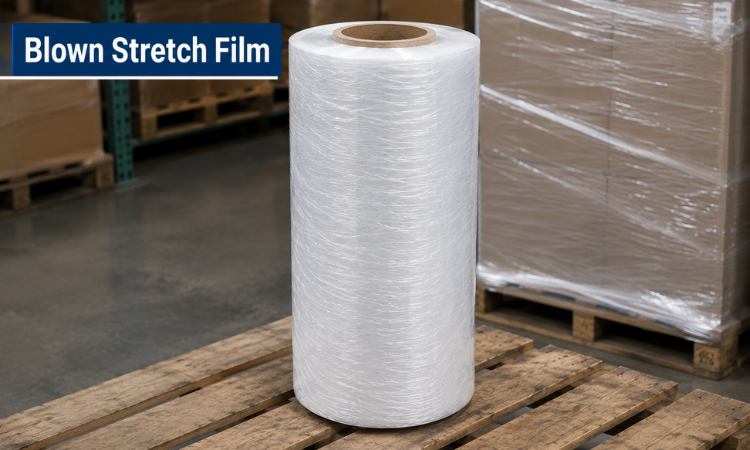
Blown stretch film is produced by melting plastic resin and forcing it through a circular die to form a large tube or bubble. The bubble is then cooled gradually with air before being flattened and wound into rolls.
This slower cooling process creates a stronger molecular structure, making blown stretch film tougher and more resistant to punctures and tears than cast stretch film.
Key Features of Blown Stretch Film
Blown stretch film is designed for demanding industrial applications where maximum load security is essential.
Its key features include:
- Excellent puncture resistance for sharp or uneven loads.
- High tear resistance to prevent the film from ripping easily.
- Strong load-holding force for improved pallet stability.
- Superior cling that keeps products securely wrapped.
- Greater elastic memory for maintaining consistent tension.
Although it has a hazier appearance and produces more noise during unwinding, its strength makes it a preferred choice for heavy-duty packaging.
Advantages of Blown Stretch Film
Blown stretch film offers several benefits for industrial packaging operations.
- Outstanding resistance to punctures and tears.
- Maintains excellent load stability during long-distance transportation.
- Performs well in cold storage and varying environmental conditions.
- Suitable for wrapping irregular, heavy, or sharp-edged products.
- Reduces the risk of pallet shifting during shipping.
Its durability makes it one of the most reliable options for businesses handling challenging loads.
Limitations of Blown Stretch Film
Despite its strength, blown stretch film also has a few disadvantages.
- Higher manufacturing cost than cast stretch film.
- Noisier during application due to its rougher surface.
- Lower transparency, making barcode and label scanning slightly more difficult.
- Requires greater stretching force during manual wrapping.
For businesses wrapping standard or lightweight pallets, cast stretch film may provide a more economical solution.
Best Applications for Blown Stretch Film
Blown stretch film is recommended for heavy-duty industrial packaging where load security is the top priority.
It is commonly used for:
- Construction materials
- Metal components and fabricated products
- Heavy machinery and industrial equipment
- Chemical and fertilizer packaging
- Export pallets for international shipping
- Products with sharp edges or irregular shapes
These applications benefit from the film’s exceptional strength and high holding force.
Pre-Stretched Film: The Cost-Saving Alternative
What Is Pre-Stretched Film?
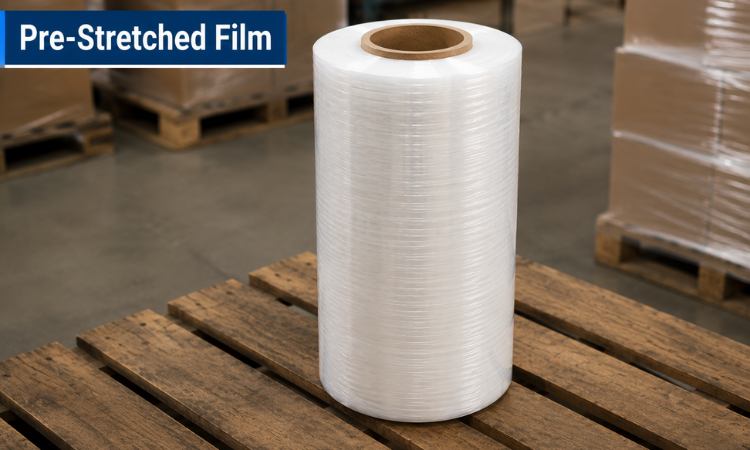
Pre-stretched film is mechanically stretched during the manufacturing process before it is wound onto the roll. Since the stretching has already been completed, the operator does not need to apply significant force during wrapping.
This makes it an excellent choice for manual packaging operations where reducing physical effort and material consumption is important.
Benefits of Pre-Stretched Film
Pre-stretched film offers several practical advantages for businesses looking to improve efficiency.
- Uses less film per pallet, reducing material costs.
- Requires minimal physical effort during hand wrapping.
- Reduces operator fatigue and improves workplace ergonomics.
- Delivers more consistent wrapping results.
- Helps minimize film waste caused by over-stretching.
- Increases productivity in manual packaging operations.
Because the film has already been stretched, operators can wrap pallets more quickly while maintaining consistent tension.
Limitations of Pre-Stretched Film
Although pre-stretched film is highly efficient, it is not suitable for every application.
- Limited ability to stretch further during use.
- Lower holding force than cast or blown stretch film.
- Not recommended for heavy, unstable, or irregular pallet loads.
- Less effective when maximum load containment is required.
For demanding industrial applications, blown stretch film usually provides better protection.
Ideal Applications for Pre-Stretched Film
Pre-stretched film is best suited for:
- Light to medium-weight pallet loads
- Manual pallet wrapping
- Retail distribution centers
- Warehouses with frequent hand wrapping
- Businesses focused on reducing packaging material costs
- Operations aiming to improve worker comfort and productivity
It is particularly popular among companies looking to lower stretch film consumption without compromising wrapping consistency.
Cast vs Blown vs Pre-Stretched Film: Side-by-Side Comparison
Feature | Blown Stretch Film | Cast Stretch Film | Pre-Stretched Film |
Stretchability | Moderate | High | Very Low (Pre-done) |
Holding Force | Excellent | Good | Fair |
Puncture Resistance | Excellent | Moderate | Low to Moderate |
Clarity | Low (Hazy) | High (Glossy) | High |
Noise | Loud | Quiet | Very Quiet |
Cost Efficiency | Moderate | High | Very High |
Suitable Method | Machine & Hand | Machine & Hand | Hand primarily |
Best Load Type | Heavy, irregular | Uniform, standard | Light, stable |
Quick Comparison
If your priority is maximum strength, choose blown stretch film.
If you need excellent clarity and lower packaging costs, cast stretch film is the better option.
If your goal is to reduce film usage and operator fatigue during manual wrapping, pre-stretched film provides the best value.
Selecting the right stretch film depends on your load weight, packaging method, transportation requirements, and overall operating costs. Understanding these differences helps businesses improve pallet stability, reduce packaging waste, and achieve better efficiency across warehouse operations.
Which Stretch Film Should You Choose?
Instead of guessing and matching the film for your specific product:
- Lightweight cartons & retail goods: Casting Film (cheap and clear)
- Heavy machinery & sharp edges: Blown film (resistant to puncture)
- Export pallets & long transit: Blown film (higher holding film)
- Food & Beverages: Casting Film (easy barcode scanning)
- Construction materials plus chemicals: Blown films (durable and tough)
- Manual wrapping of the light loads: Pre-stretch films (saves labor and material)
How Stretch Film Thickness Affects Packaging Performance
Thickness that’s measured in microns (µm). However, that’s always better. A high-quality and thinner machine stretch films for 250% will outperform a thicker stretch by only 50%.
Load Type | Recommended Thickness (Microns) |
Light loads (Uniform boxes) | 15 µm to 20 µm |
Medium loads (Mixed boxes) | 20 µm to 25 µm |
Heavy loads (Irregular/sharp) | 25 µm to 30 µm+ |
Balancing protections and costs that can mean finding the thinnest film that can hold the specific load that’s stretched correctly.
Common Mistakes When Selecting Stretch Film
Many businesses increase packaging costs or experience load failures simply because they choose the wrong stretch film. Avoid these common mistakes to improve efficiency and reduce waste.
Choosing Film Based Only on Price
A cheaper roll is not always more economical. Lower-quality films may require additional layers to secure a load, increasing overall material consumption and labor costs.
Ignoring Load Weight and Shape
Using cast stretch film for heavy or sharp-edged products can result in punctures, torn film, and unstable pallets. Always match the film type to the characteristics of your load.
Using Hand Stretch Film on Machine Wrappers
Hand stretch film is designed for manual application and does not have the tensile strength required for automated wrapping machines. Using it on a machine can lead to frequent film breakage and production downtime.
Applying Too Much or Too Little Film
Overwrapping increases material costs without improving load stability, while underwrapping may cause products to shift or fall during transportation. Applying the correct number of wraps ensures both protection and cost efficiency.
Expert Tips to Reduce Stretch Film Consumption
For getting the most of this industrial stretch films and stretch film for pallet wrapping:
- Optimize machine settings: Increase those pre-stretching percentages for the wrapper (for instance, from 200% till 250%).
- Use proper overlap: A standard basic 50% overlap is enough; applying more is just wasting film.
- Check the pallet quality: Splintered wood pallets can puncture even the best blown films. Fix the pallet and not just the film.
- Use the right wrapping pattern: Use those “roping” techniques (bunching films) for the added vertical stability without the need for extra layers.
Frequently Asked Questions
Which Is the Strongest Type of Stretch Film?
Blown stretch film is considered the strongest type of stretch film. It offers excellent puncture resistance, high tear strength, and superior load-holding force, making it ideal for heavy, irregular, or sharp-edged pallet loads.
Which Stretch Film Is Best for Heavy Pallets?
Blown stretch film is the best choice for heavy pallets because it provides greater holding force and elastic memory than other stretch film types. It helps keep loads stable during transportation and reduces the risk of shifting or product damage.
Is Cast Stretch Film More Affordable Than Blown Stretch Film?
Yes. Cast stretch film is generally more affordable because its manufacturing process is faster and more efficient. It is an excellent option for businesses wrapping uniform pallet loads where maximum puncture resistance is not required.
Can One Wrapping Machine Use Different Types of Stretch Film?
Yes. Most modern pallet wrapping machines can use different stretch film types, including cast and blown stretch film. However, the machine’s tension and pre-stretch settings should be adjusted according to the film being used. Hand stretch film should not be used on automated wrapping machines, as it may break during operation.
What Is the Difference Between Hand Stretch Film and Machine Stretch Film?
Hand stretch film is designed for manual wrapping and is lightweight and easy to handle. Machine stretch film is manufactured for automated pallet wrapping systems and offers higher stretch capacity, improved durability, and better performance in high-volume packaging operations.
Does Thicker Stretch Film Always Provide Better Protection?
No. A thicker film does not always deliver better performance. A high-quality stretch film with excellent stretchability and load retention can often outperform a thicker film with lower elasticity. Selecting the correct film type and thickness based on your pallet load is more important than choosing the thickest film available.
Conclusion
Each type of stretch film has its strengths. Choosing the exact film for your needs will help in load stability, reduce costs, and overall minimize product damage during transportation. Whether you require the clarity of cast film or the toughness of blown film, the ergonomic benefits of pre-stretch film that matches your material for that specific load are the key to warehouse efficiency. Selection of the right film works great when it’s paired with a perfect wrapping machine. Upgrading to the automated and modern wrapping machine thus ensures that it’s used to its best potential and saves money on each pallet.