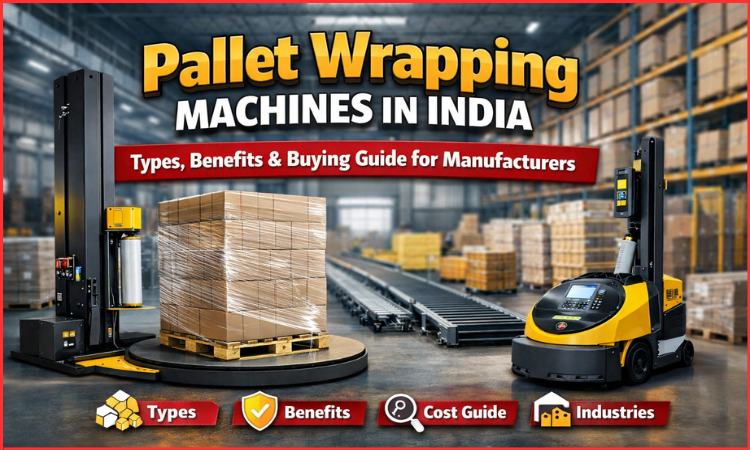
In today’s fast-moving Indian manufacturing and logistics environment, safe and efficient pallet packaging is no longer optional. With increasing dispatch volumes, rising labour costs, and strict delivery commitments, manufacturers need reliable pallet packaging solutions. A pallet wrapping machine ensures that palletized goods remain stable, protected, and professional-looking during storage and transportation. From FMCG and pharma to exports and e-commerce, pallet wrapping machines have become an essential part of modern secondary packaging operations in India. What is a Pallet Wrapping Machine? A pallet wrapping machine is a packaging machine that wraps stretch film tightly around products stacked on a pallet. This wrapping keeps the load secure, prevents movement, and protects goods from dust, moisture, and damage during handling and transport. How a Pallet Wrapping Machine Works The pallet is placed on the machine (turntable or floor position). Stretch film is attached to the pallet load. The machine rotates the pallet or wrapping arm. Film is stretched and wrapped evenly around the load. Multiple layers are applied for stability. Film is cut automatically or manually (based on machine type). The wrapped pallet is ready for dispatch or storage. Manual Pallet Wrapping vs Pallet Wrapping Machine Industries Using Pallet Wrapping Machines in India FMCG Industry Used to secure large volumes of packaged goods, liquids, and household products while ensuring fast dispatch cycles. Pharmaceutical Industry Ensures clean, stable, and contamination-free packaging for long-distance transport and export compliance. Food & Beverage Industry Provides hygienic and moisture-resistant pallet packaging, especially for export shipments. E-commerce & Retail Warehousing Improves speed and safety while handling high order volumes and mixed pallet loads. Exporters & Logistics Companies Helps meet international shipping regulations and prevents transit damage during domestic and global transport. Healthcare & Industrial Units Used for wrapping heavy machinery parts and raw materials to ensure safe handling and storage. Types of Pallet Wrapping Machines in India Manual Pallet Wrapping (Traditional Method) How Manual Wrapping is Done Workers manually wrap stretch film around the pallet by walking around it and pulling the film by hand. Limitations High labour dependency Uneven and inconsistent wrapping Excessive film wastage Why Manufacturers Are Shifting Away Manual wrapping increases operational cost, reduces consistency, and cannot handle growing dispatch volumes efficiently. Semi-Automatic Pallet Wrapping Machines What is a Semi-Automatic Pallet Wrapper? A semi-automatic pallet wrapping machine uses a motorized turntable or arm to wrap pallets, while the operator loads and unloads the pallet. How It Works Operator places pallet on the turntable Film is attached manually Machine performs automatic wrapping cycles Key Features Turntable system Adjustable tension control Consistent and repeatable wrapping Best Suited For Small to mid-scale manufacturers Low to medium pallet volumes Fully Automatic Pallet Wrapping Machines What Makes It Fully Automatic? Fully automatic machines require no manual intervention and work seamlessly with automated production lines. Key Capabilities Integration with conveyor systems Automatic film cutting and clamping Minimal human involvement Ideal For High-volume production units Large warehouses Export-oriented companies Rotary Arm Pallet Wrapping Machines When to Use Lightweight or unstable loads Tall pallets that cannot rotate Advantages Over Turntable Machines Pallet remains stationary Safer for fragile loads Faster wrapping cycles Preferred Industries Pharma FMCG Chemical and electronics manufacturers Mobile / Robot Pallet Wrapping Machines What is a Robotic Pallet Wrapper? A mobile pallet wrapping robot moves around the pallet and wraps it without fixed installation. Benefits High flexibility Space-saving design Suitable for large or irregular pallet sizes Best Applications Large warehouses Multiple wrapping locations Limited floor space facilities Benefits of Using Pallet Wrapping Machines for Indian Manufacturers Improved Load Stability & Safety Prevents load shifting during transport Reduces damage and customer complaints Reduced Packaging Cost Optimal stretch film usage Less film wastage Long-term cost savings Higher Productivity & Faster Dispatch Faster wrapping cycles Smooth warehouse operations Lower Labour Dependency Reduced manpower requirement No skilled labour needed Professional & Export-Ready Packaging Clean and uniform wrapping Meets export packaging standards Manual Wrapping vs Pallet Wrapping Machine : Comparison Table Factor Manual Wrapping Pallet Wrapping Machine Speed Slow Fast Film Usage High wastage Optimized Labor High Low Consistency Uneven Uniform Cost per Pallet High Lower Industries That Should Invest in Pallet Wrapping Machines Manufacturing plants Warehouses & 3PL companies Pharmaceutical companies FMCG & food processing units Exporters & logistics hubs in Delhi NCR How to Choose the Right Pallet Wrapping Machine in India Factors to Consider Daily pallet volume Load size and weight Available warehouse space Type of stretch film Budget and ROI expectations Common Mistakes to Avoid While Buying Choosing a machine only based on price Ignoring after-sales service support Not checking film compatibility Underestimating future production growth Maintenance Tips for Long Machine Life Regular cleaning Film carriage inspection Proper operator training Scheduled servicing Conclusion: Is a Pallet Wrapping Machine Worth the Investment? For Indian manufacturers, investing in a pallet wrapping machine delivers clear benefits—lower packaging costs, faster dispatch, reduced labour dependency, and professional packaging quality. With India’s manufacturing and export sector growing rapidly, automated pallet packaging is not just an upgrade but a necessity. From ROI improvement to future-ready operations, pallet wrapping machines are a smart investment for businesses aiming to scale efficiently.
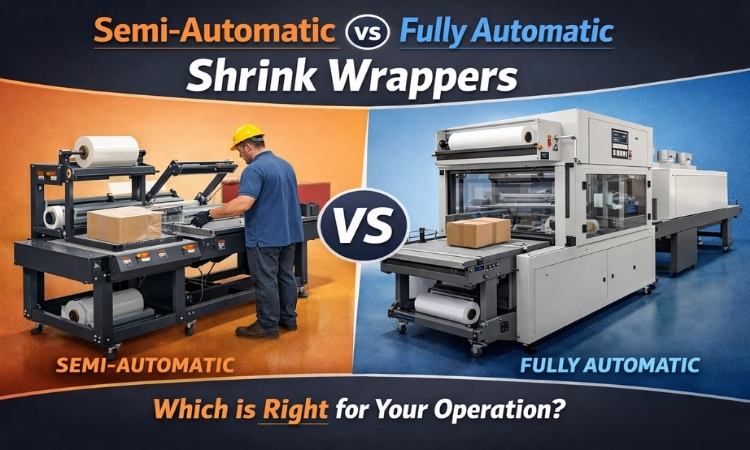
Semi-Automatic vs Fully Automatic Shrink Wrappers: Which Is Right for Your Operation?
Packaging is not just about wrapping a product—it is an important part of protecting goods, improving product presentation, and making transportation safer. The right packaging machine can also increase production efficiency, reduce labour costs, and help businesses maintain consistent packaging quality. When choosing a shrink wrapping machine, many manufacturers face one common question: Should they invest in a semi-automatic or a fully automatic shrink wrapper? While both machines provide secure and professional packaging, they are designed for different production volumes, budgets, and business requirements. In this guide, we’ll compare Semi-Automatic vs Fully Automatic Shrink Wrappers based on their working process, features, investment, production capacity, maintenance, and ideal applications. By the end, you’ll have a clear understanding of which machine is the right choice for your business. Understanding Shrink Wrapping Machines What Is a Shrink Wrapping Machine? A shrink-wrapping machine is a packaging system that wraps products using shrink film and seals them tightly. The packaging is done in such a way that the product remains protected until it is transported to the consumer. Common Industries Using Shrink Wrappers Shrink wrapping machines are mainly used by various industries, such as: Food and beverage manufacturing Pharmaceutical industries Crockery industry Printing, stationery, and publishing Cosmetics and personal care products Electronics and hardware Why Shrink Packaging Is Popular in Indian Manufacturing Shrink packaging has become a preferred packaging solution across Indian industries because it protects products from dust, moisture, scratches, and handling damage during storage and transportation. It also gives products a clean, professional appearance while reducing packaging waste. From food and beverages to pharmaceuticals, electronics, cosmetics, and industrial goods, shrink wrapping helps businesses improve packaging quality and operational efficiency. Types of Shrink Wrapping Machines: Manual Shrink Wrapping:- This machine is one in which wrapping is mostly done by the operator. It is best suited for low-volume production packaging. Semi-Automatic Shrink Wrapping Machines:- In this machine, the combined efforts of the machine and human labour are used for sealing and packing of products. Fully Automatic Shrink Wrapping Machines:- This machine performs all packaging operations on its own, including feeding, wrapping, sealing, and shrinking, with minimal human effort. What Is a Semi-Automatic Shrink Wrapper? How Semi-Automatic Shrink Wrappers Work In a semi-automatic shrink wrapping machine, the product is placed by the worker on the sealing platform. After sealing, the product moves through a Shrink tunnel, where heat tightens the film uniformly Workflow of a Semi-Automatic Shrink Wrapping Machine: Placement of the product manually. The automatic machine seals the product. Heat shrinking in the tunnel. Manually unloads the product. Key Benefits of Semi-Automatic Shrink Wrapping Machines Among medium-production-based businesses, semi-automatic machines are considered very beneficial. Costs are comparatively low. The operating and maintenance costs are very simple and economical. The working process is flexible for products of different sizes. They require less floor space. They are compact and occupy a small area. For businesses entering organized packaging, a semi-automatic shrink wrapping machine provides a practical starting point. Limitations of Semi-Automatic Shrink Wrappers The working speed of these machines is comparatively slower than that of fully automatic shrink wrappers. There is greater dependence on workers for operating the machine. They are not suitable for large-scale production of products. Best Use Cases for Semi-Automatic Shrink Wrappers Small manufacturers Start-ups and growing businesses Businesses with low to medium production volumes A dependence on a shrink wrap machine for a small business What Is a Fully Automatic Shrink Wrapper? How Fully Automatic Shrink Wrapping Machines Work A fully automatic shrink wrapping machine performs the entire packaging process on its own, including product placement, packaging, heat shrinking, and unloading. Very minimal human involvement is required. The worker only operates and monitors the machine. Advantages of Fully Automatic Shrink Wrappers A fully automatic shrink wrapping machine offers different benefits such as:- The working speed of this machine is very fast. Uniform and high-quality packaging is achieved. Less dependence on manual labour and limited to operating the machine. Ideal for large-scale production and bulk packaging of products. Drawbacks of Fully Automatic Shrink Wrapping Systems Therefore, fully automatic systems also have some disadvantages Machines are higher in price. Their installation requires a large amount of space. Working flexibility is limited, as they are generally suitable for one type and size of product. The automatic shrink wrap machine price in India can be a deciding factor for many businesses Ideal Applications for Fully Automatic Shrink Wrappers Large-scale manufacturing industries Export-oriented businesses FMCG and Beverages plants Industries requiring large numbers of packaged products Semi-Automatic vs Fully Automatic Shrink Wrappers – Detailed Comparison Semi-Automatic Shrink Wrappers Suitable for small to medium businesses and startups. Moderate speed; operator handles product placement and guidance. Flexible for different product sizes and quick changeovers. Lower initial investment and easy installation in compact spaces. Simple maintenance does not require highly skilled technicians. Fully Automatic Shrink Wrappers Designed for high-speed, large-scale production. Automatic feeding, wrapping, sealing, and shrinking with minimal labor. Ideal for standardized products; handles 100–200+ products per hour. Higher upfront cost but better long-term efficiency and ROI. Requires more floor space and skilled technical support for maintenance. Key Differences Speed & Output: Fully automatic is faster; semi-automatic depends on the operator. Cost: Semi-automatic is cheaper initially; fully automatic saves labor over time. Flexibility: Semi-automatic handles various product sizes; fully automatic works best for standardized items. Labor: Semi-automatic needs skilled operators; fully automatic requires minimal staff. Space & Maintenance: Semi-automatic fits small spaces and is easy to maintain; fully automatic needs more space and technical support. Expert Tip: The best shrink wrapping machine is not always the most expensive one. A semi-automatic machine can be a smarter investment for businesses with moderate production volumes because it offers flexibility at a lower cost. Fully automatic machines deliver better returns when production is continuous and packaging demand is high. Always choose a machine based on your daily production, available space, and future growth plans. Comparison Table: Semi-Automatic vs Fully Automatic Shrink Wrappers Feature Semi-Automatic Shrink Wrapper Fully Automatic Shrink Wrapper Production Speed Medium
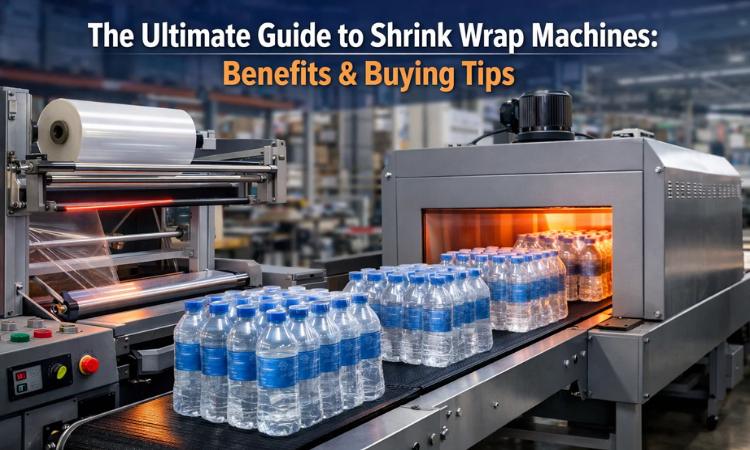
The Ultimate Guide to Shrink Wrap Machines: Benefits & Buying Tips
A shrink wrap machine is one of the most practical and widely used packaging tools in modern manufacturing. Shrink wrapping tightly encloses products in plastic film. When the plastic wrapper comes into contact with heat, it shrinks and fits closely around the product. The result is a clean, secure, and professional-looking package. In India, shrink wrapping has become essential as manufacturers focus on safety, speed, and consistency. Industries such as FMCG, pharmaceuticals, food and beverages, logistics, and e-commerce depend on shrink wrapping to protect products during storage and transportation while keeping costs under control. What Is a Shrink Wrap Machine? A shrink wrapping machine is a type of equipment used to offer protective wrapping for products. It employs a heat-shrinkable plastic film, which shrinks tightly over the product when exposed to heat, providing a secure, tamper-evident, and protective security feature. Role in Secondary Packaging Group multiple products into one pack. Protects items from dust, moisture, and damage. Improves handling and transportation efficiency. Enhances self-appearance. How Does a Shrink Wrapping Machine Work? Step-by-Step Shrink Wrapping Process 1. Film Wrapping The product is placed on the conveyor or platform and wrapped with shrink film, either manually or automatically, depending on the machine type and production requirements. 2. Sealing The sealing unit cuts and seals the shrink film around the product, creating a loose bag that fully covers the product before heat is applied. 3. Shrink Tunnel Heating The sealed product passes through a shrink tunnel, where controlled heat shrinks the film tightly around the product’s surface, giving it a polished finish. Key Components of a Shrink Wrap Machine Sealing unit Shrink tunnel Polishing system Control panel Types of Shrink Wrap Machines Manual Shrink Wrap Machines It is Suitable for small-scale uses. It requires low investment. Best for startups and low-volume packaging Semi-Automatic Shrink Wrap Machines It’s Ideal for medium production lines. It can provide a balance between cost and automation. It requires minimal manual handling. Automatic Shrink Wrap Machines It is also designed for high-speed industrial packaging. This is Ideal for pharmaceutical plants. It can provide consistent output with minimal labor. Shrink Tunnel Machines It’s very compatible with PE and PVC films. It also gives high output efficiency. This machine ensures uniform heat distribution. Benefits of Using Shrink Wrap Machines Shrink wrap machines offer several advantages over manual packaging methods. Enhances product protection during storage and transportation Provides tamper-evident packaging, meeting market and regulatory requirements Reduces overall packaging costs Saves space and improves pallet stability Improves product presentation on shelves Minimises packaging waste These benefits make shrink wrapping an efficient and reliable solution for manufacturers aiming for faster output, lower damage rates, and consistent packaging quality. Industries That Use Shrink Wrap Machines FMCG & Consumer Goods Shrink wrapping helps maintain packaging consistency and protects products during distribution. Food & Beverages Protect food and beverages from moisture during transportation and storage. Pharmaceutical and Healthcare It provides tamper evidence in pharmaceuticals, which also helps maintain hygiene guidelines. Logistics & Warehousing Balances the loads and less the movement of goods during transportation time. E-commerce & Retail Protect the shipment and improve the customer unboxing experience. Shrink Wrap Machine Price in India The price of a shrink wrap machine in India depends on the machine type, capacity, and level of automation. Manual shrink wrap machines: ₹25,000 to ₹50,000Suitable for small businesses with low packaging volumes Semi-automatic shrink wrap machines: ₹80,000 to ₹2,50,000Ideal for small to medium-scale production units Fully automatic shrink wrap machines: ₹2,00,000 to ₹8,86,000+Designed for high-speed and large-scale operations How to Choose the Right Shrink Wrap Machine Key factors to choose the right shrink wrap machine: Production volume is required. Product shape and size are essential for the right shrink machine. Floor space is also space in a machine. Product grouping arranges the individual items or pieces to make the available bundle or pack. Companies or businesses’ needs will increase in the future. It’s reliable after-sales support in India. Choosing the wrong machine can slow down productivity, and if we choose the right machine, it makes the business more efficient and reduces long-term costs. Shrink Wrap Machine vs Other Packaging Methods Here, we’ve compared Shrink wrapping with Stretch wrapping and other wrapping methods: Shrink wrapping Stretch wrapping Shrink wrapping is a packaging material made up of polymer-based plastic, commonly polyolefin, polyvinyl-chloride, or polyethylene. When the shrink wrapping is heated to a specific temperature, it shrinks uniformly around the product being packaged. Heat is usually applied to the wrapping with a heat gun or a heat tunnel. Stretch wrapping is an extremely stretchy polymer-based plastic wrapping that is used to wrap pallets of products for shipping. The elasticity of the film ensures that the items are bound very tightly. Stretch wrapping is commonly used in tandem with a stretch wrapping machine to ensure the superior load containment of pallets. Shrink wrapping Cartoon Packaging Shrink-wrap uses a plastic film commonly polyethylene, polyolefin, or PVC that wraps around products and is heated to shrink tightly. This creates a protective, tamper-evident seal that conforms to the shape of the item or group of items. It is budget-friendly for high-volume runs. Resistant to moisture and dust particles. Carton packaging is generally used in corrugated or paperboard boxes to enclose products. Cartons offer structure, printability, and stackability. It is easy to stack and store. Fine structural protection against impacts. It is also widely recyclable and made from renewable sources. Why Choose Dipack for Shrink Wrapping Solutions? For the best shrink wrapping machine, Dipack is an Indian company that has one of the best choices for shrink wrapping solutions. The company has a strong Indian manufacturing expertise Introduced shrink-wrapping machines and other advanced packaging equipment. Machines are designed to offer custom- built and secondary packaging solutions and provide complete installation and service support. It makes industry-specific machine designs. Whether in the FMCG, food and beverage, pharmaceutical, or cosmetics industry, Dipack shrink wrapping machines provide a perfect solution to protect, package, and enhance the packaging line. Dipack focuses on reliable machines
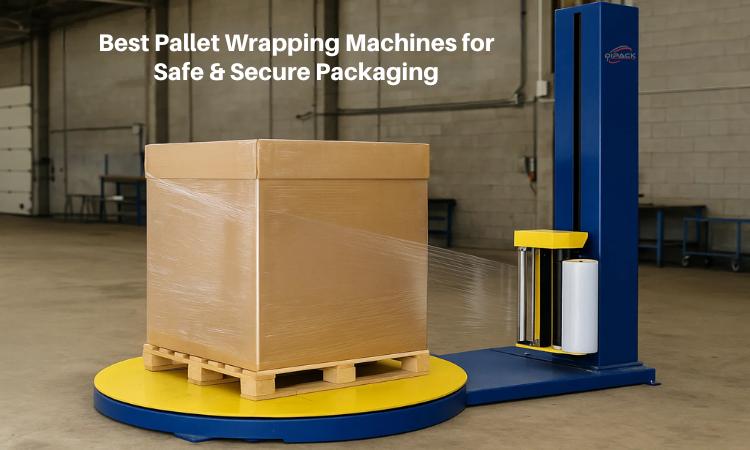
Best Pallet Wrapping Machines for Safe & Secure Packaging
As the prowess of India booms in the manufacturing and e-commerce sectors, just a single damaged consignment can cost a lot in returns and the trust lost. Choosing a perfect packaging machine, and specifically the pallet wrapping machine in India, is a lot more than just convenience—this is a frontline defense for the revenue loss. This guide helps warehouse managers & logistics teams, along with e-commerce businesses, that can select the perfect wrapping solutions for securing loads and cutting costs, plus boosting efficiency. We will be breaking down different machine types and key features as well as a practical selection checklist so you can make an informed decision for the sales jargon. What is a pallet wrapping machine? A pallet wrapping machine is actually a system that can secure goods on pallets with the use of a stretch film, thus preventing shifting during transit. This replaces manual wrapping, as manual wrapping can be labor-intensive and inconsistent. Commonly called a stretch film, wrapping film, or pallet wrapper (or automatic pallet wrapper in India), these systems can be used for turntables for arms to apply film under controlled tension. Whether handling the fragile electronics or the heavy automotive parts, the right machine thus ensures that loads can arrive in intact condition for optimizing film usage—this is important for Indian businesses that are facing rising material costs, along with tight delivery schedules. Types of Pallet Wrapping Machines These are the different types of pallet wrapping machines that can help in e-commerce and other industries for packaging needs: Semi-Automatic Turntable Wrappers The semi-automatic turntable machine is great for small to mid-size warehouses and can handle around 15 to 20 pallets every day. The operator can place the load on a rotating platform while the film carriage can move vertically. Pros: Affordable, towards ₹3 to ₹6 lakhs, that can easily operate, and minimal training is needed. Cons: This machine is slower, as it is slower than fully automatic machines and requires the manual placement of loads. This machine is great for small businesses and SMEs that require flexibility without any kind of high upfront investment. Fully-Automatic Turntable Wrappers (Conveyor-Fed) Great for high-volume operations (around 30+ pallets each hour), these types of automatic Indian pallet wrapper systems have become the backbone of modern e-commerce fulfillment centers. Loads through it can glide in a fast and seamless manner from the conveyor belt to the wrapper, where the sensors can easily autodetect the load’s weight and height and apply the right tension for different kinds of electronics & heavy grocery lists. Pros: Complete hands-free operation (no need of operator input) & completely even wrapping in midnight cycles, consistent wrapping for the midnight shifts & full integration with the advanced WMS software for fast & real-time tracking. Cons: Higher costs for ₹8 to ₹15 Lakhs, required for the 10 to 15 ft of liner space for complete conveyor integration. Indian Context: The Bangalore hub of Flipkart uses these machines to do wrapping of 500+ pallets every day for the Diwali season—simply reducing costs by around 35% for the motorized pre-stretch. Choose this if: You can ship 100+ pallets every day and cannot even afford any kind of delays (e.g., FMCG distributors like Instamart, Big Basket, or others). Rotary-arm wrappers The rotary-arm wrapping machine does rotate a film carriage around a stationary pallet—great for both unstable or tall loads or any kind of heavy loads (like textile bales, steel coils, or different kinds of agricultural machinery). This is a great machine for handling different kinds of loads and of different sizes; whether the load is big or heavy or of unique shape, the pallet wrapping machine in India is a great option. Pros: Can easily handle loads up to 3 m in height (great for Indian textile exporters stacking fabric rolls), no floor space needed for turntable operations & saves precious warehouse real estate & also prevents load shifting for monsoon. Cons: Higher level of maintenance (dust-resistant motors that are recommended for dusty factories) and slightly pricier (₹7 to ₹12 lakhs). Example: Tata Motors unit in Pune uses these for securing engine blocks for securing engine blocks—reducing the transit damage for around 60% of the rural roads. Choose this: That your loads wobble, for instance (coiled wires from the Gujarat suppliers), or you don’t have the space for turntable systems. Orbital / Ring Wrappers The orbital & ring wrappers where the pallet moves for the vertical ring for the film – like for a car wash for cargo. This machine is great for long and narrow items like lumber, pipes or furniture. This machine is great for packaging longer items in a simplified manner and provides a way towards packaging goods for transportation, and provides safety during that. Pros: These machines can wrap oddly shaped loads ( no weak spots for the pipe ends) and can handle heights for upto 4m ( great for construction material) & these machines can work in tight spaces. Cons: Niche used along with limited availability for India ( just for 3 to4 suppliers), higher pallet wrapping machine price India for around ₹10 to ₹18 Lakhs using the Indian context – Example: Furniture exporters use this for securing tabletops & eliminating breakage the furniture exports for securing of marble. Choose this if: You want to ship the non-standard cargo and where traditional wrapping methods can fail. Why This Matters for Indian Businesses Cost Reality: While semi-auto wrappers start at ₹3 lakhs, fully automatic systems pay for themselves in 10 months by saving ₹18,000/month on film/labor (based on DIPACK client data). Local Adaptation: Rotary-arm wrappers now feature monsoon-proof electrical enclosures (IP55 rating)—a must for Mumbai or Chennai warehouses. Hidden Tip: For pallet wrapping machines for e-commerce, prioritize programmable cycles—your “festival season” setting (tighter wrap for fragile gifts) should differ from “monsoon mode” (extra moisture protection). Type Best For Throughput Footprint Price Range Semi-Auto Turntable SMEs & seasonal businesses 5-20 pallets/hour Compact ₹3-6 lakhs Fully-Auto Turntable E-commerce & FMCG hubs 30-60 pallets/hour Large (conveyor) ₹8-15 lakhs Rotary-Arm Heavy or irregular loads 15-30 pallets/hour
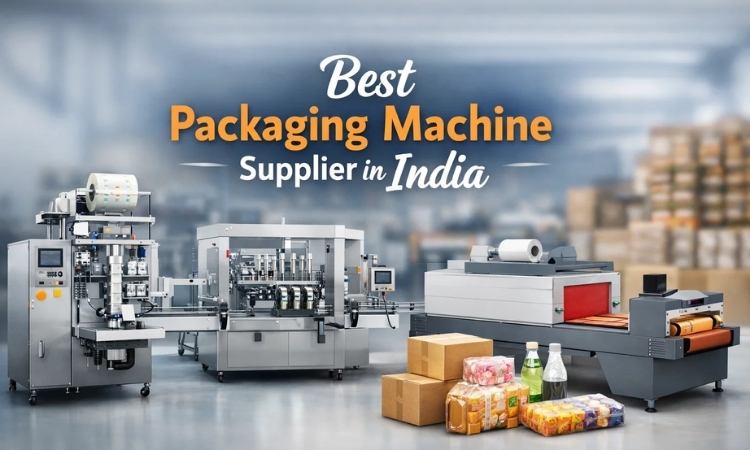
Top 5 Packaging Machine Supplier in India in 2026
The industrial sector regarding packaging is on a major rise in 2026, as this happens in automation. Fueled by FMCG expansion and the growth of e-commerce, along with the government-backed automation drives, businesses across India are racing ahead of each other to modernize their packaging tech. But with multiple suppliers that are claiming to be the best, it can be an overwhelming task. Is this about some flashy tech? Or the lowest prices? Or the one that can’t vanish after the time and sale are over. This blog is about helping you with the right information that removes all the noise and wrong information. We will be comparing the best machine suppliers in India, and everything will be done based on real-world factors, such as support, technology, and trust, so you can have the best for your business. Spoiler: This is more than just about the machine. India’s Packaging Industry in 2026: By the Numbers Forget the “growing” aspect—the packaging sector in India is expanding fast. One of the contributors to this fast growth is e-commerce (around 40%, as in 2023 numbers), the demand for FMCG in Tier 2 or Tier 3 cities, and the push towards the “Make In India” campaign. The industry will actually hit around $120 billion by around 2026 (that’s up by around $85 billion in 2023). Sustainability can be a major option—78% of the brands do use eco-friendly films. Advanced packaging machines with the major IoT sensors can actually prevent around 90% of the transit damage. Even small companies and factories are leaving manual taping solutions and going for automatic packaging machines India. The message is clear: old or outdated packaging = less profits or lost profits. How to Spot the Real Best Packaging Machine Supplier Just forget the major “Top 5” list and focus on the Best Packaging Machine Supplier in India, and you need to nail these things: Factors Why This matters Technology IoT machines that can predict failures or errors before these happen (no more afternoon breakdowns!). Product Range One-stop area for strappers, stretch wrappers, sealers? Saves you with dealing from multiple vendors After-Sales Support A broken machine equates to halted production. Can they fix it today? (Not “next week.”) Pan-India Service Delhi’s support won’t work with your other area warehouses. Local engineers equate to zero downtime. Certifications ISO 9001 isn’t more than a badge – it’s actually proof your machine will not fail safety audits. Real Client Proof Case studies from the industry specifically yours. Top 5 Packaging Machine Suppliers in India (2026) Here’s a totally honest look at exactly who is leading the pack—this is not paid rankings, and there are no vague claims here. We evaluated each supplier against multiple factors that can actually impact the daily operations (real-world reliability, tech support), more than brochure specs. As your packaging lines will not be able to support guesswork: 1. Dipack Proshield: Offering around 20+ years of excellence—that solves 1,200+ packaging challenges across India. They have the coverage for everything: from those high-speed stretch wrapping machines for the e-commerce giants to the sterile carton giants, along with sterile carton sealers that are meeting pharma’s hygiene standards. These are best for brands that need pan-India support (12 service hubs) along with zero-downtime guarantees—for the 87% of breakdowns that are resolved in 24 hours. Trusted by top companies across India. Also Read : How Dipack is Revolutionizing Secondary Packaging in India? 2. Akash Pack Tech Akash Pack Tech is a Faridabad-based manufacturer with over 20+ years of experience in primary packaging machines. They specialize in VFFS, flow wrap, sachet, and auger filling machines, mainly serving food, pharma, and agrochemical industries, with exports to 15+ countries worldwide. 3. Shrijeta Global Another player in India for the packaging machinery that is marketing machinery for quality equipment and service. Shrijita Global also has a great presence across India and provides different machines for packaging. 4. Shruti Flexipack Specialization towards flexible packaging solutions that are known for quality, competing directly with the offerings from DIPACK corporation. 5. JOY PACK (INDIA) Pvt. Ltd. JOY PACK is a Delhi-based packaging machine manufacturer offering shrink wrapping machines, stretch wrapping machines, strapping machines, carton sealing machines, and other packaging solutions. The company serves various industries with machines designed to improve packaging speed and efficiency. Comparision: Top Packaging Machine Suppliers in India (2026) Dipack Proshield Akash Pack Tech Shrijeta Global Shruti Flexipack Joy Pack (India) Location Delhi Faridabad Faridabad Navi Mumbai Delhi Category Secondary packaging, Primary/pouch packaging Primary/pouch packaging Primary/pouch packaging Primary/flexible packaging Secondary packaging Experience 14+ years 23+ years Since 2015 12+ years Not stated Core Machines Stretch wrap, shrink wrap, strapping, carton sealing VFFS, flow wrap, sachet, auger/weigh fillers Collar-type FFS, multi-track, lined carton VFFS/bagger, sachet, flow wrap, retort pouch Shrink/stretch wrap, strapping, L-sealers, carton sealers Certifications ISO 9001:2015, ISI, CE ISO-certified Not stated Not stated Not stated Export Reach Pan-India 15+ countries Nepal, Bangladesh, UAE & others Growing exports Domestic only Dipack Proshield leads for secondary packaging — ISO 9001:2015 certified, pan-India technical support, 14+ years focused solely on stretch wrap, shrink wrap, strapping, and carton sealing. Why Dipack Stands Out as the Leading Supplier in 2026 Let’s be clear here. Most of the suppliers here sell machines. Dipack Proshield, on the other hand, is solving both major and minor packaging problems that these industries face each day. Here’s why Dipack has become the leading supplier in 2026: Decades of fixing packaging solutions for companies. Full portfolio of machines from strapping systems, stretch wrappers, and carton sealers—all solutions under one roof. We Fix it Now policy: 87% of these breakdowns got resolved in around 24 hours at service hubs across India. Proven through giants and trusted by leaders in industry, from e-commerce and FMC G, and pharma brands. Future-ready: Machines are compatible with the recycled films, along with advanced diagnostics. Real Results: How Dipack Helped an FMCG Brand The real challenge: A snack maker in Gujarat state used to waste around 2 hours/day with the manual sealing
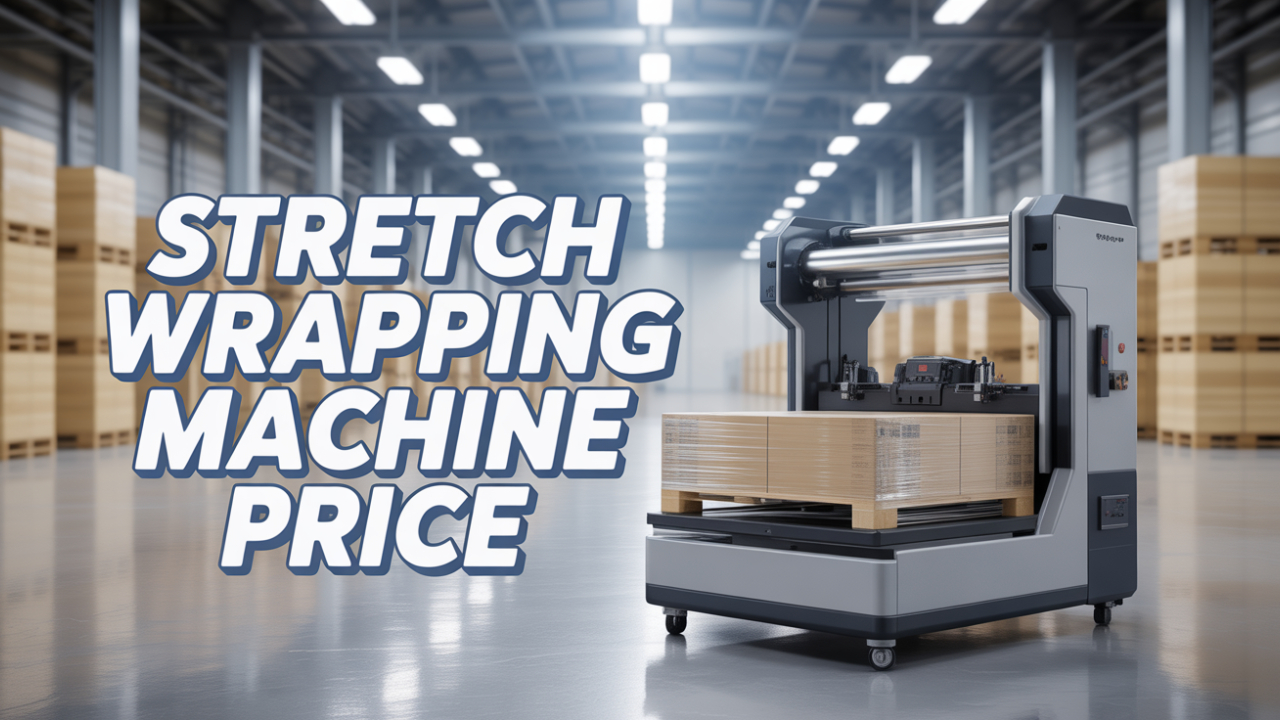
Stretch Wrapping Machine Price in India (2026 Guide)
Stretch wrapping machines are becoming essential for businesses that actually handle packing and shipping in India. From warehouses to e-commerce and FMCG companies, these machines really help secure products, save time, and reduce manual effort. Knowing the stretch wrapping machine price in India is important before even making a purchase, so that you can choose the right model for your needs. In this guide, we’ll explain the latest prices for semi-automatic, fully automatic, and custom machines, the factors that affect costs, and tips to make the best choice for your business. What is a Stretch Wrapping Machine? A stretch wrapping machine is a packaging machine that is used to provide tight and secure wrapping of products or pallets with stretch film. In fact, assists in maintaining the stability of items during either storage or transportation, minimizing harm and accelerating the packing procedure. Furthermore, these machines may be semi-automatic or even fully automatic, which type of automation suits you. Thus, a stretch machine is not only more efficient but also reduces the labor cost and maintains uniform packaging quality How it Works: The machine holds a roll of stretch film that wraps around the pallet or products. Then, the film stretches tightly around the items, and secures them for safe transport. Advanced machines can even detect the size of the load and automatically adjust the wrapping tension and number of layers. Industries Where Stretch Wrapping Machines Are Widely Used: FMCG Packaging bulk goods like beverages, snacks, and household products. Pharmaceuticals: Securing medicine pallets for safe storage and shipment. Warehouses & Logistics: Efficiently preparing products for transportation and storage. E-commerce: Protecting shipments from damage during last-mile delivery. Automotive & Manufacturing: Wrapping heavy or irregular-shaped products for secure transit. Using the right stretch wrapping machine ensures smoother operations, reduces product damage, and ultimately provides a reliable solution for businesses that are looking to improve packaging efficiency. By understanding the stretch wrapping machine price in India, companies can choose models that perfectly fit their budget and operational needs. Buy Strech Wrapping Maching Price Range of Stretch Wrapping Machines in India (2026) Stretch wrapping machines are available in various types, all depending on your business needs, and their prices vary accordingly. And knowing the cost really helps plan your investment better. Here’s a quick look at the typical price range: Box Wrapper Machines: ₹55,000 – ₹2,50,000, Great for small to medium-sized boxes. Pallet Wrapper Machines: ₹2,90,000 – ₹3,50,000, Perfect for securing pallets in warehouses and logistics. Jumbo Reel Machines: ₹5,50,000 – ₹7,50,000; these are designed for large-scale operations. Shrink Wrapping Semi-Automatic Machines: ₹25,000 – ₹6,50,000, good for smaller packs and retail products. These prices actually give a clear idea of what to expect whenever planning for a stretch wrapping machine. So, choosing the right type totally depends on your business size, product type, and operational requirements. Factors Affecting Stretch Wrapping Machine Price in India Automation Level: Fully automatic stretch wrapping machines are even more expensive than semi-automatic ones, as they offer advanced features, faster operation, and automated tension control, saving time and labor over the long term. Machine Size & Load Capacity: Machine size and load capacity are other factors that influence price. Large machines designed for heavy pallets or bulk shipments cost more than smaller machines. Higher capacity ensures efficient wrapping of bigger loads and reduces packaging time. Brand & Build Quality: Brand and build quality also matter. Premium brands with durable construction, reliable components, and consistent performance are priced much higher. When you choose a reputable brand, it actually ensures longevity, fewer breakdowns, and better overall return on investment. After-Sales Service & Warranty: Machines with excellent after-sales support, timely maintenance, and warranty coverage may cost more in the initial phase; however, long-term value is achieved by minimizing downtime and reducing repair expenses. Cost vs Value: Why Cheapest is Not Always Best In the case of stretch wrapping machines, the cheapest is not necessarily the best decision. Since cheap machines can save in the short run, the unseen expenses, such as maintenance, breakdown, and downtime, can become very high. Alternatively, a strong, well-built machine may prove to be expensive in the short term, but in the long term, you end up spending less money on fixing it, and less strain on your staff. At Dipack, we are actually concerned about quality and reliability. All machines are rigorously quality checked, and our after-sales services mean that you are never found at a crossroads trying to figure out a technical problem. And, the time to pick the machine is not all about the price tag. On top of that, it is also a question of long-term efficiency, peace of mind, and streamlined business. How to Choose the Right Stretch Wrapping Machine? Not every stretch wrapping machine is similar, and selecting the wrong machine may even make the work. Therefore, a machine that fits your business size and type of load, as well as workflow, is the one that will guarantee efficiency, minimization of the number of products damaged, and packaging without complications. Here are the ways you can select the right one: Business Size: Small warehouse or retail units can utilize semi-automatic machines. On the other hand, large factories, logistics hubs, or even MNCs need fully automatic machines for higher speed and capacity. Industry Use Case: FMCG and e-commerce companies wrap pallets of packaged goods, whereas pharma, automotive, and solar industries need machines designed for heavy or fragile products. Buying Checklist: Evaluate daily packaging volume, compare stretch wrapping machine price, check brand reputation, warranty, after-sales service, and ensure the machine fits your workflow and space. Dipack’s Stretch Wrapping Solutions Dipack offers a wide variety of stretch wrapping machines in order to suit every business’s needs. From semi-automatic machines for small warehouses to fully automatic machines for large factories and logistics centers, we’re here to provide solutions that save time, reduce damage, and improve packaging efficiency. Our machines are trusted across several industries, including FMCG, e-commerce, pharmaceuticals, automotive, solar panels, and more. Each machine
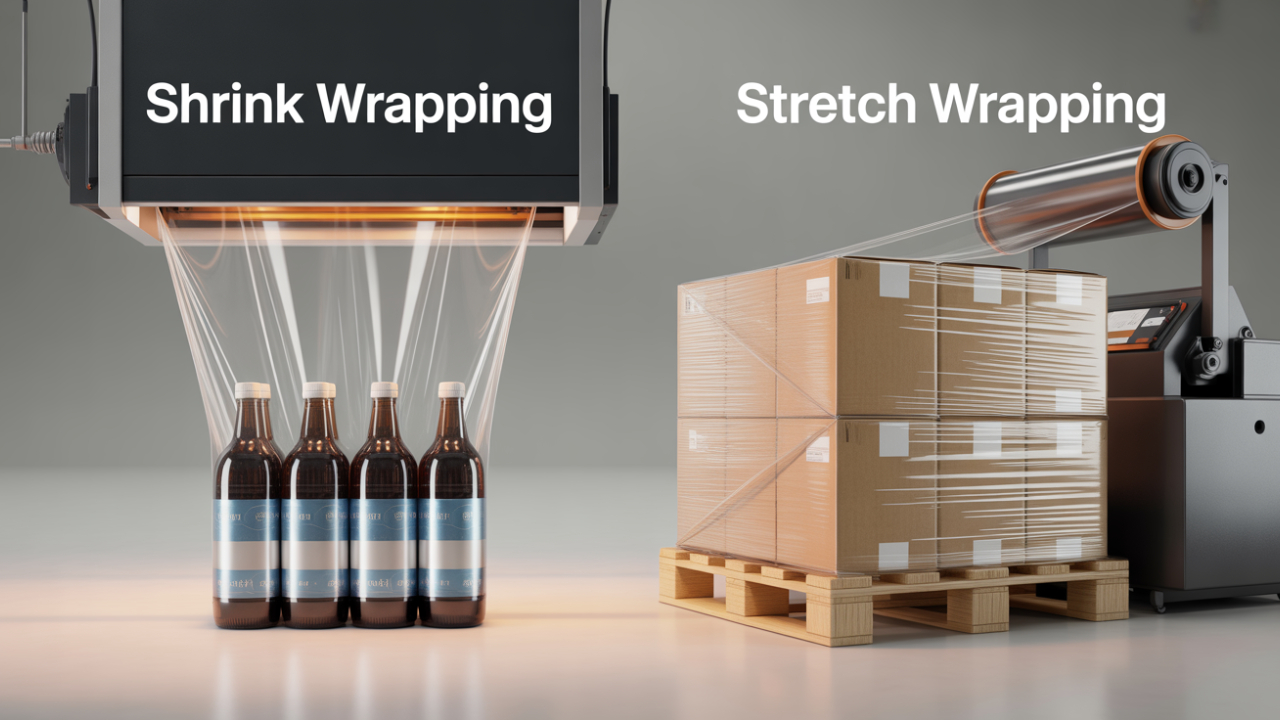
Shrink Wrapping vs Stretch Wrapping – Which One to Choose?
Shrink Wrapping vs Stretch Wrapping – Which One to Choose? Great packaging is not just about putting your product in a box. This is only your first line of defense against your product getting damaged or getting stolen and, in turn, generating zero revenue. Still, multiple businesses have to choose between shrink wrapping vs stretch wrapping, thus leading to costly mistakes. When you look into shrink wrap vs stretch wrap, it leads towards costly mistakes. For shrink wrap’s sleep that finishes towards investment. Does the stretch wrap make smarter picks? Let’s just start with our confusion for a no-jargon comparison. What is shrink wrapping? Shrink wrapping that uses heat tightly conforms plastic film (POF vs PVC) around products. Here’s how this works for: The product that’s placed for loose plastic sleeves. This passes through a heat tunnel (or is blasted towards it with a heat gun), shrinking that film snugly around it. The result? A smooth and tamper-proof seal for showcasing the product. Where these shine FMCG & Retail: Snack multipacks, bottled beverages, and cosmetics. Pharma: Blister packs and for medicines that need sterile & dust-proof protection. Examples: An 8-pack of shampoo bottles wrapped in glossy film—retail ready and impossible to open without any kind of damage. What is stretch wrapping? Stretch wrapping generally secures different items through the use of stretching films that are elastic in nature—as in LLDPE—and does not use heat to do that. The process of stretch wrapping involves: Goods being palletized sit on a turntable. A rotating arm that’s attached to the machine stretches that LLDPE film fully around the load. The tension of that film holds goods in place during the transit process. Where This Works: Logistics and Warehousing: Canned goods in pallet-waypackaging, heavy machinery, and stacked cartons. Bulk Shipping: Furniture, steel coils, or appliances create Example: A bigger pallet of around 50 cereal boxes can be wrapped in stretch films and can be transported across long routes. tretching films that are elastic in nature—as in LLDPE—and does not use heat to do that. The process of stretch wrapping involves: Difference between shrink and stretch wrapping Let’s look at the key differences between shrink wrapping vs stretch wrapping in a tabular form for easy and fast understanding. Features Features Shrink Wrapping Stretch Wrapping Methods Heat Shrinking on the product Mechanical film stretching around/on load. Great for Smaller articles like Electronics, bottles, etc Bigger pallets or bulk shipments Costing Higher costs ( Requires Energy + Heat tunnels) Lower Costs – Basic Machine + Film Speed Medium Speed (heat application requires time) Quick ( around 60 pallets/hr) Tamper Evidence Yes (Film can easily break open and cannot be remodelled ) No ( Can be reapplied and reopen easily) Display Appeal High ( Product visibility, glossy) Loose film and not retail ready When you look at the differences for shrink vs stretch wrap, both have different use cases and require different solutions to work. Pros and Cons: The Real Deal Let’s look at the pros and cons of shrink vs stretch wrap and how they have diffearent ways of use: Choose shrink wrapping if: Your product has to go on a retail shelf (e.g., cosmetics, snacks). Tamper-proof is not negotiable (premium goods, pharma). Your prioritization is brand image, and you do not consider swift delivery. Choose Stretch Wrapping if: You have to move goods in pallet form to different warehouses. Budget constraints and speed are important to you. Loads are irregular/heavy (furniture, steel, appliances). Still confused? Ask yourself this question: “Will customers see this packaging?” If yes, then choose shrink wrapping; otherwise, go with stretch wrapping. DIPACK’s Packaging Solutions: No Guesswork Needed In DIPACK packaging solutions, we will slice through all your confusion of getting the right equipment, those needed for exact workflow: Shrink Wrapping: Our L-bar sealers can easily create bundles that are retail-ready for FMCG sectors (like snack multipacks or bottled beverages), thus reducing the film wastage by around 22% through the use of advanced precision control along with tension control. Stretch Wrapping: Rotary arm machines that can easily wrap around 55+ pallets/hour—great for all those e-commerce giants for nationwide delivery. The machines can handle unstable loads, such as furniture, ensuring zero shifting and reducing transit damage claims by approximately 32%. All these solutions, whether you choose shrink wrapping or stretch wrapping or any other packaging solution, come with 24X7 free site assessments, plus complete technical support, along with the compatibility with the recycled eco-films (cutting the carbon footprint by around 18%). Still unsure? Simply talk to our experts, and we will provide the perfect machine in just 15 minutes, backed by real-world case studies from the particular industries. Conclusion: Stop Overcomplicating Packaging The major difference between shrink and stretch wrapping generally comes down to one major question. Who can see the package? Choose shrink wrap if your stuff goes onto the retail shelf and customers can see your products. Otherwise, choose stretch wrapping for better logistics and pallet wrapping needs. Ignoring these factors can waste money, resources, and your manpower that handles these tasks. Ready for the advanced and effective wrapping? Simply get in touch with DIPACK for all your packaging needs. Connect today! And find the right packaging solutions that can boost your packaging process.
Packaging Machines for Paper Mills – Cost, Benefits & Setup Guide (2026)
The Indian paper industry is changing rapidly because of increased demand and competition. Paper mills are under pressure to reduce expenses, increase productivity, and provide products that are packaged safely. Packaging machines can help with this. Traditionally, many mills have relied on manual labour for bundling, strapping, and wrapping paper. While it works, it often leads to delays, errors, and higher expenses. However, the entire process is made faster, safer, and more dependable by packaging machines. They help paper mills meet large orders stress-free, save manpower, and reduce waste. In this blog, we will examine the real value of packaging machines for paper mills in 2026. You’ll learn about the costs, how to set up the machines, and the long-term benefits that make them worth the money. If you’re thinking about adding automation to your paper mill, this guide will help you get started. Why Paper Mills Need Packaging Solutions Heavy-duty paper reels and cartons:- Large cartons and heavy, bulky reels are produced daily by paper mills. It takes a lot of time and work to handle them by hand. Packaging machines securely wrap and strap these large loads, simplifying the process. Reducing damage during transport and storage:- If not packed properly, paper reels may tear, scratch or lose their shape. Machines ensure tight, uniform packaging, which keeps products safe during transport and while stored in warehouses. Meeting high production demand:- Paper mills frequently deal with big orders and short turnaround times. Packing by hand slows down delivery. Automated packaging solutions keep up with production speed and ensure orders reach customers on time. Key Benefits of paper packaging machines Cost Savings: Mills can reduce waste from uneven manual packing and additional labour costs by using machines. Product Safety: To prevent damage during handling, transportation and storage, machines securely wrap paper in straps or protective film. Speed & Efficiency: In the time it takes for workers to pack a few reels or cartons, machines can pack dozens of them. As a result, overall productivity increases. Consistency: Every reel or carton is packed the same way, which creates a professional look and ensures reliability. Worker Safety: There is a lower risk of workplace injuries when there is less manual lifting and handling. Workers can focus on supervision instead of heavy physical labour. Modern paper mills require packaging machines because they offer the perfect balance of speed, safety, and cost savings. Types of Packaging Machines for Paper Mills Paper mills use different packaging machines depending on the type of product and the packaging needs. Here are some of the main ones: Reel Wrapping Machines – These are made for big kraft paper rolls. They wrap the reels tightly with stretch film or paper to keep them safe during handling. Stretch Wrapping Machines – Useful for packing pallets and bundles. They wrap products with stretch film so they stay firm and secure during transport. Shrink Wrapping Machines – Best for cartons and paper reams. Heat is used to shrink the plastic film around the product, giving strong and neat packaging. Carton Forming & Sealing Machines – These machines shape flat cartons into boxes and then seal them, perfect for finished paper products like stationery. Strapping Machines/Tools – Used to strap reels, cartons, or pallets. Strapping adds extra strength and holds everything tightly together. Cost of Installing Packaging Machines in Paper Mills (2026) Cost range:- Packaging machines come in a wide range of price points. The price of a large fully automatic system for reels or pallets can reach ₹15,00,000 while small semi-automatic machines may start at ₹1,00,000. Automation Level. Although semi-automatic machines require some manual labour, they are less expensive. Though they are more expensive, fully automated machines ultimately save more time and labour. Maintenance & Consumables. Mills have to budget for consumables like straps, shrink film and stretch film in addition to the cost of the machine. To keep the machine operating smoothly, regular maintenance is essential. For Example, a 500-ton-per-month paper mill can recoup its investment in a matter of months. The machine rapidly recoups its investment through labour cost savings, waste reduction, and increased delivery speed. Packaging machines are more than just a financial investment. They are a long-term savings investment. Steps to Set Up Packaging Machines in a Paper Mill Assess the production needs:- Determine how much paper you make first and then what kind of packaging—such as reels, cartons or pallets—is needed. Select the appropriate machines:- Choose equipment that complements your offerings. For example, a reel wrapping machine for rolls, a shrink wrapper for cartons, or strapping machines for pallets. Prepare the installation and layout:– Decide the best spot in the mill to install the machines so they work smoothly without causing any disturbance. Provide staff training:- For workers to safely and effectively operate and maintain the machines, they must receive the necessary training. Post-purchase assistance:– Make sure the supplier offers prompt service and spare parts at all times. Best Practices for Maximising Machine Usage Use good quality films:- Always use shrink film or sturdy stretch film. High-quality materials keep reels, cartons, and pallets safe during handling and transport. Low-quality film can damage products and tear easily. Regular machine servicing:- Packaging machines require routine maintenance, much like any other machine. Longer machine life and fewer breakdowns are achieved by routinely cleaning, oiling, and inspecting parts. Train operators:-Skilled operators make fewer mistakes, operate more quickly and are safer. Training them lowers the number of accidents and helps them to use the machine to its maximum capacity. Go digital with monitoring:- IoT-enabled packaging machines are a possibility. This does real-time tracking of maintenance requirements, downtime and usage. In addition to increasing efficiency, digital monitoring lowers unexpected failures. Why Choose Dipack for Your Paper Mill 25+ years of expertise:- With decades of experience in packaging solutions, we are a well-known brand in this sector. Specialised machines for heavy-duty paper industry needs:- Our machines are specifically made to meet the demanding requirements of pallets, cartons, and paper reels. Nationwide installation & service
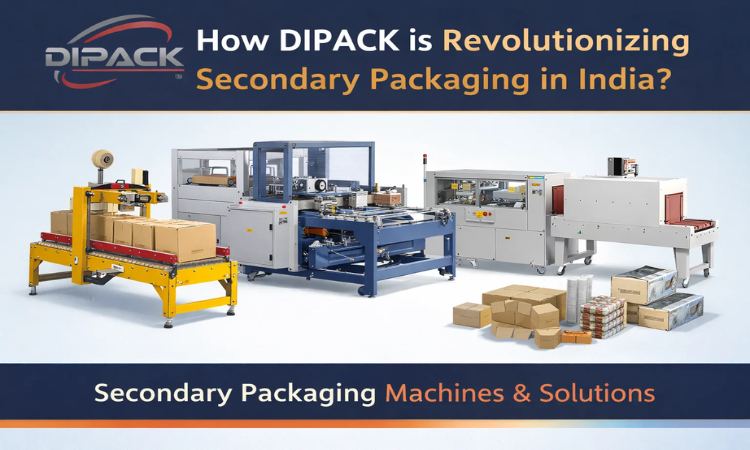
How DIPACK is Revolutionizing Secondary Packaging in India?
How DIPACK is Revolutionizing Secondary Packaging in India? It’s 2026 and people today aren’t only looking for good products but also good packaging. They want to make sure that companies pack their product thoughtfully to keep it safe for transport and its demand is growing rapidly. Product packaging involves three stages- primary, secondary and tertiary. All three stages are to ensure that your customers get their packages safely, at a fair price, and with ease. That is where DIPACK comes in. DIPACK offers secondary packaging machines and systems, providing smart, reliable, and future-ready secondary packaging solutions in India to suit your business. Understanding Secondary Packaging Machines and Its Importance: packaging is the immediate wrapping around products that provide instant safety to the product. Secondary packaging is putting the products in small boxes or using plastic stretch wraps to secure these before shipping. Secondary packaging solutions in India have become essential because they offer easier handling, storage, and shipping. Examples: Carton sealing to pack products in boxes. Uses PP/PET bands (polyester straps) to bind the products. Using plastic films to Primary stretch/shrink wrap products for bulk transportation. Why is this important to you? Secondary packaging protects your product. It reduces the exposure to damage, product loss, or return charges. It reduces the waste, percentage of manual rework and expense across the overall packaging cycle. A good packaging always makes your customers happier! Neglecting secondary packaging solutions in India not only increases the risks of your products getting harmed but also creates a negative impact in your buyer’s minds. This ultimately loses you customers, missing your next sale and long-term wealth. Overview of DIPACK’s Product Portfolio DIPACK is your one-stop shop for all of your packaging machines. These secondary packaging machines are fit for use in different businesses, large or small. Here is what you can expect to find: 1.Stretch Wrapping Machines This machine wraps plastic stretch films around the boxes to secure them completely against instability, dust, and moisture, and promote safe storage & shipping. 2.Shrink Tunnel Systems It uses heat to shrink the film and tamper-seals your products that tightly packages the product and keeps it safe, and offers your product a clean & professional look. 3. Plastic Strapping Machines DIPACK plastic strapping machines tighten robust plastic straps around cartons, parcels, or heavy materials, keep the bundles together and offer safe shipping. They come in two types: Semi-automatic: Requires operator to begin and end process Fully automatic: Capable of running on its own in a high-speed line. Carton erecting & sealing systems: Carton erecting & sealing systems automatically fold boxes (cartons) into shape and seal using tape. This saves your team from hectic manual work every day. 4.Carton erecting & sealing systems: Carton erecting & sealing systems automatically fold boxes (cartons) into shape and seal using tape. This saves your team from hectic manual work every day. 5. Consumables: PP/PET strapping bands: These are robust, lightweight strapping that you can apply through strapping machines. Stretch films: These are clingy films used for wrapping and stabilizing goods. Shrink films: This uses plastic that shrinks with heat and makes for a great touch packaging. BOPP tapes: This uses clear, strong tapes used for sealing boxes. What Sets DIPACK Apart? When you select DIPACK, you get access to advanced benchmark packaging technology and user-friendly experience that support your innovative business needs. Here are some reasons why DIPACK feels different. Innovation Design: Every machine is designed to make complex packaging “super-simple and high-speed.” You can expect varieties of easy to use operations and decreased down time. Durable Performance: Equipment such as sophisticated plastic strapping systems operate for years and require little maintenance. Pan-India Support: DIPACK operates on PAN-INDIA level and therefore you get 24/7 customer support irrespective of any city. You can find spare parts easily & professional consultants to repair or buy a new device anytime required. Experience That Counts: DIPACK has over thirteen years of experience and knowledge in servicing a wide variety of industries, including FMCG, pharmaceuticals, logistics industries, e-commerce, and more. Its demonstrated cost, overhead savings and increased packaging quality have shown gradual growth over the years & made customers love the brands. Choosing DIPACK is not just choosing a machine; it assures you continuous improvement and maximum return on investment in our partnership. Real-World Applications and Industry Use Cases: DIPACK secondary packaging machines are already solving real problems in key sectors: 1.Logistics & Warehousing: DIPACK machines create an automatic system to make your logistic & warehouse workflow smarter and more efficient. It uses PET strapping to secure the items that offer an ideal packaging for long-distance transport, offers fully-automated & high-speed operations to both types of logistics operations- SMEs for daily packaging & large product packaging operations. 2. E-commerce: DIPACK secondary packaging machines offer versatile box strapping, fulfilling all your personalised e-commerce requirements. It reduces the manual handling workload, sorts the products early, and increases tamper resistance for safe transportation. 3.Manufacturing: Using DIPACK machines helps manufacturing with robust strapping for heavy items and wire reels and on-site manual working dependency by 30%. DIPACK VS Competitors: DIPACK is distinct, as a full system and not just machines, but also the consumables and service to keep you running. Some suppliers may sell you a machine, but DIPACK is different: Feature DIPACK Generic Suppliers Machine + Consumables Yes (integrated) No (machines only) Pan-India Demos & Support Yes Limited Maintenance Easily accessible and quickly scheduled Usually reactive and may take time Rapid Spares Delivery 24/7 support, fast turnaround Often delayed DIPACK helps you avoid unexpected additional costs, have complete assurance of support and be able to maximize machine uptime. Why Choose DIPACK Now? Here are a few reasons for you to choose DIPACK as your packaging solutions partner: DIPACK’s secondary packaging machines claim less packaging times, and improve your product’s

How a Pallet Stretch Wrapper Can Reduce Shipping Damages?
How a Pallet Stretch Wrapper Can Reduce Shipping Damages? Have you ever opened a shipment to find your products spoilt with moisture, shifted, or damaged entirely? Shipping damages are a tremendous hassle in logistics, whether they happen from loads moving during the journey, vibration from the vehicles and ships, or just dust and moisture. Who should account for the damages? What if you could protect your goods with the easiest, most reliable method there is? That is what a pallet wrapping machine does. By tightly binding your products with stretch film, a pallet wrapping machine will protect the products from shifting, and exposing your products to environmental hazards. This is going to save you a lot of time and money. Let’s discover how a pallet wrapping machine can make your shipments safer and push your business into another level of efficiency. Common Causes of Shipping Damages Nowadays, shipping damage has increased because of poor loading, not securely wrapping, or rough handling, which leads to late deliveries. Here are some common causes of shipping damages that you can avoid- Load shifting While loading the pallets, they can fall or lean because of poor and insecure packaging. Sudden stops, turns, and uneven roads can harm the product, which leads to repacking and refunding, which in turn leads to time loss and money loss. Vibration Long-distance transportation is often riskier for items to get damaged. Because of rough roads and turns, the pallets can move, even the smallest vibration can make the packaging loose and fall if not wrapped properly. Moisture Moisture can ruin packaging, especially items like electronics, papers, foods, or pharmaceuticals. If the product is not wrapped correctly, then it has a high chance of getting mold, damage, or product spoilage. Impacts During loading and shipping, if the pallets are not wrapped properly, they can get bumped, scratched, or even hit by something like a forklift. Without proper wrapping, items can break, get scratched, fall from the stack of pallets, etc. How Pallet Stretch Wrappers Prevent Damage? If pallets are not packed securely, then they can slip while shopping. Pallet stretch wrappers prevent the risk of damage because of their strength and tight wrapping. Secure items tightly to prevent movement While transporting, stacks of items can move due to sudden turns, stops, and bumps, which can harm the items if not secured tightly. Stretch wrapping machine stretches the film to its original size before wrapping it around the pallets tightly, securing it, and preventing harm. Protects against dust and moisture Other than movements during transportation, there are also other things that are harmful, like dust and moisture, because of environmental exposure. For long-distance shipping or storing, packaging needs to be good, not only to prevent any movement but also to protect against dust and moisture. Types of Pallet Wrappers for Damage Prevention The designs of wrappers play a big role, especially according to the size of the product. Choosing the right type of pallet stretch wrapper can be important not only for speed and efficiency but also to prevent shipping damage. Here are some types of pallet wrapping machine– Automatic vs. semi-automatic wrappers Semi-automatic stretch wrappers are not fully automatic, but it does the work with speed and efficiency. These machines need an operator to place the pallet or stacks of items on the turntable, and sometimes they also need to change the film roll. Automatic stretch wrappers don’t need any involvement of any operator; it does the work all by themselves, from placing the pallet on the turntable to wrapping and securing it. Both of the stretch wrappers do the work with speed and efficiency. Rotary arm vs. turntable wrappers In the Rotary arm, a pallet of items stays in its place while the wrapping arm rotates around it, making it stable and wrapped tightly. This is usually used for heavy items that are not easy to rotate or move. Turntable wrappers are commonly used for lightweight items. In this, the pallet sits on a turntable platform and rotates while the film moves vertically. It’s most commonly used for fragile and light weighted items. Case Study/Stats on Reduced Damages: ITC Limited (Juice Manufacturing Unit) regularly uses 200-250 Pallet loads per day. This was initially operated by single-use stretch film. After switching to reusable Pallet wraps, they saw significant reduction in plastic waste & paper wrapping cost. UPL Chemical Agrochemical Company processes about 250 pallets per day. They wanted to lower their plastic waste and safer movement so they switched to Pallet Wraps in 2018. Best Practices for Optimal Wrapping: Using the stretch wrapping machine correctly is important; otherwise, even the best stretch wrapping can’t prevent damage. Here are the best practices for optimal wrapping- Proper film tension and overlap techniques. Tension refers to how much pressure the stretched film has while wrapping the pallet. If the film is too loose then the load can shift or collapse, and if the film is too tight, then it can crush the pallet or fragile items. These techniques are required to learn about proper film tension. Choosing the right film thickness. Film thickness is important because it reduces the damage to the products. This plays a key role in how much weight and pressure the film can handle. For lightweight items, like tissue boxes, bottles can be wrapped in thinner film, while others can be wrapped according to their weight, which saves material. Conclusion: Damage during shipping is a major problem in logistics. Every time a product gets damaged during shipping, it leads to repacking, refunding, loss, and dissatisfied customers. This not only affects cost because of replacement and refund, but it also affects the trust of customers in the brand reputation and trust in long-term deals. By employing a pallet wrapping machine, you can provide your products with the protection they require against shifting, impact, and moisture during shipment. With the right machine and wrapping methods, you can prevent product loss, save money and improve customer satisfaction.