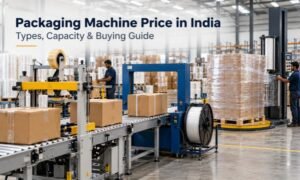

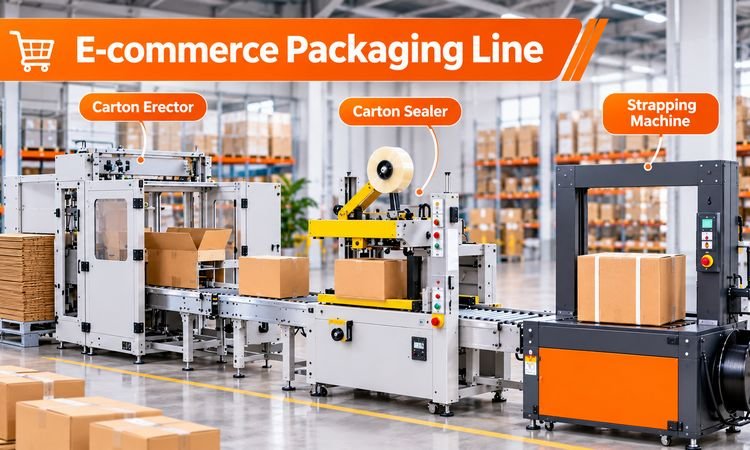
An e-commerce packaging line is a combination of machines that helps businesses prepare, close and secure shipping cartons before dispatch. A typical setup includes a carton erector for forming boxes, a carton sealing machine for closing them with tape, and a strapping machine for securing heavy or bulk shipments.
For online brands, fulfilment centres and growing warehouses, the right packaging line can improve packing consistency, reduce repetitive manual work and help manage increasing order volumes.
At 50 orders a day, manual box folding and taping may be manageable. At 500 or more, the same process can create bottlenecks, inconsistent sealing and delays during sale periods. The solution is not necessarily to automate everything. It is to choose packaging machines that match your actual workload and leave room for future growth.
This guide explains the machines used in an e-commerce packaging line, how they work together and what to consider before investing in one.
Key Takeaways
- A carton sealing machine is often the first upgrade for businesses looking to reduce manual packing work.
- A carton erector can speed up box formation when daily order volumes increase.
- Strapping machines are useful for heavy cartons, bundled shipments and pallet loads, but are not necessary for every parcel.
- Packaging line capacity should be planned around peak-hour requirements rather than daily averages.
- Carton quality, tape selection, conveyors and available floor space all affect overall performance.
What Does an E-commerce Packaging Line Include?
An e-commerce packaging line consists of machines and equipment that handle different stages of carton preparation and dispatch.
The main components include:
1. Carton Erector Machine
A carton erector automatically picks up flat corrugated carton blanks, folds them into boxes and seals the bottom flaps. It reduces the time employees spend manually preparing cartons and helps maintain consistent box formation.
2. Carton Sealing Machine
A carton sealing machine closes the top flaps of filled cartons and applies adhesive tape. Depending on the model, it can handle uniform carton sizes or different box dimensions.
3. Strapping Machine
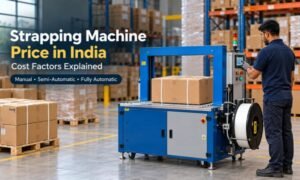
A strapping machine applies PP or PET straps around cartons, bundles or pallet loads. It provides additional holding strength for heavy products and shipments that need extra support during transportation.
4. Conveyor System
Conveyors move cartons between different packaging stations. Roller and belt conveyors can help maintain a smoother workflow and reduce the need to carry boxes manually between machines.
For a complete setup, businesses may also need packing tables, weighing equipment, label printers and carton storage areas. Employees continue handling product placement, invoices and protective inserts, while machines take over repetitive packaging operations.
Carton Erector Machine: Faster and More Consistent Box Formation
Manually folding and preparing cartons can consume considerable time when a warehouse handles hundreds of orders every day.
An automatic carton erector machine forms boxes from flat corrugated blanks and seals their bottom flaps. This allows packing employees to focus on filling and preparing orders rather than repeatedly folding cartons.
Before choosing a carton erector, consider the following factors:
- Carton size range: Check the minimum and maximum box dimensions the machine can handle.
- Changeover time: If your business uses different carton sizes, check how quickly the machine can be adjusted.
- Carton quality: Corrugated blanks should have consistent dimensions and suitable strength to avoid feeding problems and machine jams.
- Required output: Match the machine’s rated capacity with your expected peak-hour requirement.
- Available space: Consider the machine footprint and the space needed to store flat carton blanks.
Dipack Proshield offers automatic case erectors and carton-forming systems for businesses looking to automate carton preparation.
Explore Carton Forming and Sealing Systems to understand the available machine configurations.
Carton Sealing Machine: Consistent Sealing for Different Orders
A carton sealing machine is one of the most practical upgrades for an e-commerce warehouse because almost every shipping order requires a properly closed carton.
E-commerce businesses often handle different products, from small electronic accessories to kitchen appliances and larger household items. This means carton dimensions can vary considerably.
There are two common types of carton sealing machines:
Uniform Carton Sealing Machine: Designed for businesses that regularly use cartons of similar dimensions. The machine applies tape to close the top and bottom flaps, depending on its configuration.
Random Carton Sealing Machine: Designed to accommodate different carton dimensions without requiring manual adjustment for every box. It is particularly useful for mixed-order fulfilment operations.
When selecting a carton sealer, check:
- Minimum and maximum carton dimensions.
- Top and bottom sealing requirements.
- Tape width compatibility.
- Conveyor and production-line integration.
- Adjustment requirements for different carton sizes.
A properly selected carton sealing machine can improve sealing consistency and reduce repetitive manual taping. However, the final seal also depends on carton quality, flap alignment and the correct adhesive tape.
Dipack Proshield offers uniform and random carton sealing solutions, including top and bottom belt-drive configurations.
Strapping Machine: Additional Security for Heavy and Bulk Shipments
Not every e-commerce parcel needs strapping. For most lightweight individual orders, properly sealed cartons are sufficient.
However, strapping becomes useful when businesses handle:
- Heavy cartons that require additional holding strength.
- Multiple cartons shipped together as one bundle.
- Large or bulky products.
- Outbound pallets prepared for distribution centres.
- Packages that may shift or open during repeated handling.
Strapping machines use PP (Polypropylene) or PET (Polyester) straps, depending on the load and application.
Semi-Automatic Strapping Machine: Suitable for businesses with moderate packaging volumes. An operator positions the carton and feeds the strap through the machine.
Automatic Strapping Machine: Suitable for higher-volume operations where cartons move through a continuous packaging process with less manual intervention.
Automatic Carton Strapping and Sealing Machine: Combines carton sealing and strapping functions in one system, where the machine configuration and application requirements allow it.
Dipack Proshield offers semi-automatic and automatic box strapping machines, along with PP and PET strapping solutions.
Why Conveyors Matter in a Packaging Line
Installing multiple machines does not automatically create an efficient packaging line. Cartons must move smoothly between different stages without unnecessary manual handling.
Conveyors connect carton-forming, filling, sealing and dispatch areas. They help maintain a continuous workflow and reduce the effort involved in moving cartons between workstations.
Common options include:
- Roller Conveyors: Suitable for moving cartons between workstations and packaging equipment.
- Belt Conveyors: Useful when cartons need continuous movement along a defined route.
- Flexible Conveyors: Helpful for loading and unloading areas where the conveyor layout may need to change.
Before selecting a conveyor, consider carton weight, dimensions, machine height, available floor space and the distance between packaging stations.
Businesses planning multiple automated machines should consider conveyor integration during the initial layout design rather than adding it as an afterthought.
How to Calculate the Required Packaging Line Capacity
One of the most common mistakes when purchasing packaging machinery is selecting a machine based only on the average number of daily orders.
A packaging line should be able to handle the busiest periods, including festive sales, promotional campaigns and seasonal demand.
A practical planning formula is:
Required Capacity = (Daily Parcels ÷ Working Minutes) × Peak Factor × Growth Allowance
Let’s understand this with an example.
Suppose an e-commerce business processes 1,500 parcels during an eight-hour shift.
- Working time: 480 minutes.
- Daily average: 1,500 ÷ 480 = approximately 3.1 parcels per minute.
- Assumed peak factor: 3 times the daily average.
- Estimated peak requirement: approximately 9.4 parcels per minute.
- Additional 25% growth allowance: approximately 12 parcels per minute.
In this example, the business should evaluate a packaging setup capable of handling around 12 parcels per minute under the actual operating conditions.
These figures are illustrative, not a machine performance guarantee. The peak factor should be calculated using actual hourly dispatch data, and the final machine capacity should account for carton size, operator availability, changeovers and stoppages.
Which Packaging Setup Is Suitable for Different Order Volumes?
The right combination depends on how many cartons you process, how frequently box sizes change and how much automation your business needs.
Lower-volume operations: A semi-automatic carton sealing machine may be sufficient when employees can still manage box formation and product packing comfortably.
Growing e-commerce businesses: A carton erector combined with a carton sealer and suitable conveyor system can reduce repetitive work and improve workflow.
High-volume fulfilment centres: An integrated automatic packaging line may be worth considering when order volumes are consistently high and the business needs continuous carton processing.
Heavy or bulk shipments: A strapping machine can be added when shipment weight, carton dimensions or pallet-handling requirements make additional securing necessary.
A machine supplier should evaluate your carton sizes, required output and available space before recommending a configuration.
5 Common Mistakes to Avoid When Setting Up a Packaging Line
1. Buying Machines Only for Current Requirements
A machine that meets today’s output may become a limitation as order volumes increase. Consider expected business growth and peak-season requirements before purchasing.
2. Ignoring Carton and Tape Quality
Packaging machines cannot compensate for weak corrugated cartons, incorrectly sized boxes or unsuitable adhesive tape. Material quality directly affects the final packaging result.
3. Skipping Conveyor Planning
If employees still need to carry cartons manually between every machine, much of the benefit of automation may be lost. Plan the material flow before installation.
4. Underestimating Floor Space
Measure the available area for machines, carton storage, operator movement and finished shipments. Also consider access for maintenance and material replenishment.
5. Overlooking Installation and After-Sales Support
Before purchasing, confirm installation requirements, operator training, spare parts availability and breakdown support. Technical assistance is particularly important for businesses operating during peak sales periods.
What Information Should You Share Before Buying a Packaging Line?
A supplier can recommend a more suitable packaging setup when you provide accurate details about your operation.
Keep the following information ready:
- Average and peak parcels processed per day.
- Approximate parcels packed during the busiest hour.
- Three most commonly used carton sizes (L × W × H).
- Maximum carton weight.
- Corrugated carton type, such as single-wall or double-wall.
- Tape width and packaging material specifications.
- Available floor space and preferred machine layout.
- Preference for semi-automatic or fully automatic equipment.
- Expected future increase in packaging volume.
These details help determine which machines are necessary and whether a complete integrated line is justified.
FAQs About E-commerce Packaging Lines
1. What machines are required for an e-commerce packaging line?
A typical setup includes a carton erector, carton sealing machine and conveyors. A strapping machine can be added for heavy cartons, bundled shipments and pallet loads. The exact combination depends on order volume and packaging requirements.
2. Do small e-commerce businesses need fully automatic packaging machines?
Not necessarily. A semi-automatic carton sealer can be a practical starting point. Businesses can add a carton erector, conveyors and automatic equipment as their packaging requirements increase.
3. What is the difference between a carton erector and a carton sealing machine?
A carton erector forms flat corrugated blanks into boxes and usually seals the bottom flaps. A carton sealing machine closes filled cartons by applying tape to the top and, depending on the configuration, the bottom.
4. Can one carton sealing machine handle different box sizes?
Yes, certain random carton sealing machines are designed to handle different carton dimensions. However, the supported size range and adjustment requirements vary by model. Check these specifications before purchasing.
5. When should a business invest in a strapping machine?
A strapping machine is useful when a business regularly handles heavy cartons, bulk shipments, bundled products or pallet loads that require additional securing. Lightweight individual parcels may not need strapping.
6. How do I calculate the required packaging machine capacity?
Start with daily parcel volume and divide it by the actual working minutes to calculate average output per minute. Then account for peak-hour demand, operational stoppages and expected growth. Confirm the final capacity with the machine supplier.
7. What factors affect the cost of an e-commerce packaging line?
The cost depends on machine type, automation level, production capacity, carton size range, conveyor requirements and installation needs. A semi-automatic setup generally requires a different investment from a fully integrated automatic line.
8. Does Dipack Proshield provide complete packaging line solutions?
Dipack Proshield offers carton forming and sealing systems, plastic strapping machines, conveyors and other secondary packaging solutions. The appropriate combination can be discussed based on your product dimensions, packaging volume and operational requirements.
Planning an E-commerce Packaging Line for Your Business?
Choosing packaging machinery is not just about increasing speed. The right combination should match your carton dimensions, dispatch volume, available space and future production requirements.
Dipack Proshield provides carton forming and sealing systems, automatic and semi-automatic strapping machines, and material-handling equipment for different packaging applications.
Share your daily order volume, carton sizes, maximum package weight and available floor space. The team can help you evaluate a suitable packaging setup without investing in unnecessary machinery.