
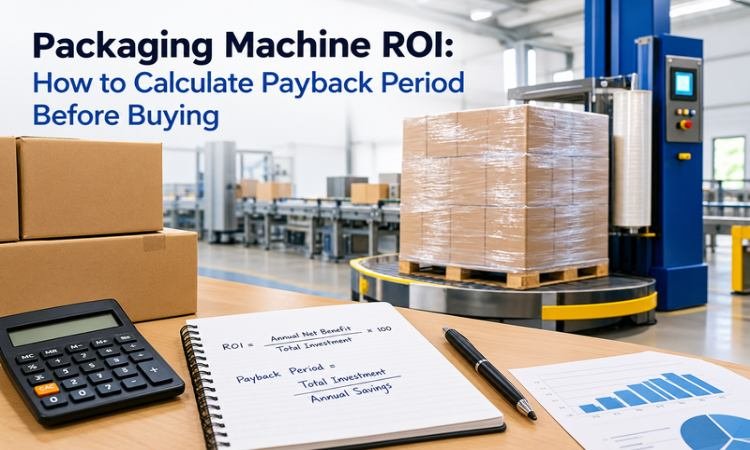
A packaging machine can save manpower, ensure packing uniformity, reduce material consumption, and improve daily production. However, these benefits must outweigh the cost of purchasing, installing, and operating the equipment.
Packaging machine ROI indicates the financial return on this investment, while the packaging machine payback period is the amount of time it takes to recover the initial investment through savings and other measurable financial benefits. Both are important for manufacturers, warehouses, and distribution centres when evaluating equipment, considering its operating costs and production requirements, and assessing the overall value of the investment over its useful life.
What Does Packaging Machine ROI Mean?
ROI (Return on Investment) for a packaging machine measures the financial return generated by the investment made in the equipment.
The formula for simple annual ROI is:
Simple Annual ROI (%) = Annual Net Financial Benefit ÷ Total Initial Investment × 100
The annual net financial benefit can include measurable savings from:
Reduced packaging labour costs
Lower material consumption
Higher production output, where the additional capacity can be used profitably
Reduced packaging-related downtime
Less rework and fewer damaged products
Other operating cost reductions directly associated with the machine
ROI can be used to compare investments, while the payback period provides an estimate of how long it will take to recover the initial investment.
These calculations provide a useful starting point for evaluating packaging equipment. However, they are estimates based on the costs, savings, and operating conditions used in the calculation.
How to Calculate Packaging Machine Payback Period
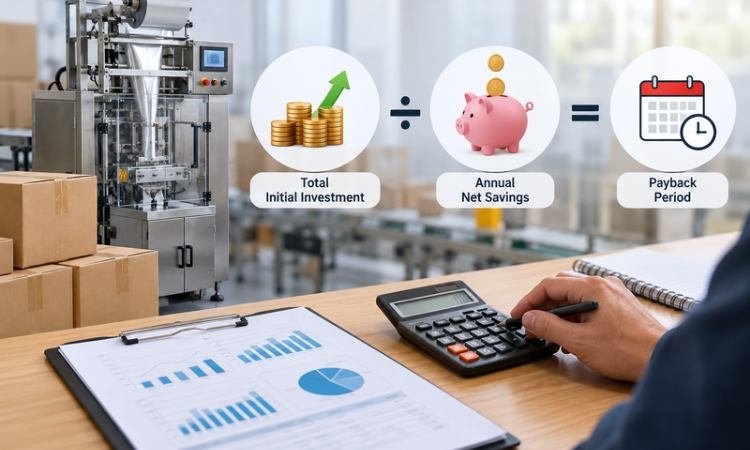
The basic formula is:
Payback Period = Total Initial Investment ÷ Annual Net Savings
For a more accurate calculation, first determine the total investment and then estimate the machine’s annual financial benefits after accounting for additional operating costs.
Step 1: Calculate the Total Packaging Machine Investment
Do not consider only the machine’s quoted purchase price. Depending on the project, the initial investment may include freight, taxes, tooling, and other necessary costs in addition to the following:
| Cost | What to Consider |
|---|---|
| Machine purchase price | Quoted equipment cost |
| Installation | Installation, commissioning, and setup |
| Electrical or infrastructure work | Required power supply, space, or supporting modifications |
| Training | Operator or maintenance training, if charged separately |
| Integration | Additional equipment or production line integration costs |
| Initial consumables | Any required startup materials |
| Freight and other project costs | Transportation, applicable taxes, tooling, and other necessary expenses, where relevant |
For example, if a machine costs ₹8 lakh and installation and related setup costs add another ₹1 lakh, the initial investment is ₹9 lakh, assuming there are no other costs to include.
Step 2: Estimate Current Packaging Costs
Do not invest in automation without establishing a baseline.
Record the costs of your current packaging process for a typical month or year. Include:
Number of employees involved in the activity
Labour hours
Packaging material consumed
Output per shift
Additional working hours or shifts required because of packaging delays
Downtime
Rework and damaged products
Current maintenance costs for the existing process
This step is important because it establishes a baseline against which you can compare the actual operating costs and performance of the packaging machine rather than relying on assumptions.
Use consistent measurement periods when comparing the existing process with the proposed machine. For example, compare annual costs with annual costs rather than comparing one month’s savings with a full year’s investment.
Step 3: Calculate the Expected Annual Savings
Packaging machines can add value in several ways.
Labour Cost Savings
Automation can potentially reduce labour requirements in a specific packaging application. Calculate the actual annual labour cost reduction resulting from the change.
For example:
Annual Labour Savings = Monthly Labour Cost Reduced × 12
Do not assume that all current employee salaries will become savings. The actual financial benefit may be different if employees are reassigned to other production tasks.
Productivity Gains
A machine can package more units in the same amount of time.
The financial value comes from the additional productive capacity, provided that the business can use it.
For instance, a 20% increase in packaged units does not automatically guarantee a 20% increase in profit. The additional production capacity must be supported by sufficient demand, available storage, adequate upstream production capacity, and a realistic opportunity to generate value from the extra output.
Only include productivity gains in the ROI calculation when they can be translated into a measurable financial benefit. Avoid counting the same benefit again under labour savings or reduced downtime.
Material Savings
In some cases, automation can improve consistency and reduce packaging material waste.
Calculate:
Annual Material Savings = Annual Material Cost Before Automation − Annual Material Cost After Automation
Use measured consumption wherever possible rather than assuming a fixed percentage reduction.
The comparison should account for changes in production volume, packaging specifications, and material prices. Otherwise, the estimated savings may not reflect the actual benefit of the machine.
Downtime and Rework
If manual packaging causes delays, inconsistent packing, or avoidable rework, the financial impact can be included when it can be measured reliably.
For example:
Annual Downtime Savings = Recoverable Financial Value from Reduced Downtime
Be careful with this figure. Lost production should only be counted as a financial benefit when the business can realistically recover that output and generate value from it.
For example, reducing downtime may allow a manufacturer to fulfil additional customer orders. However, if the business cannot sell or use the additional output, the reduction in downtime may not translate into an equivalent financial saving.
Similarly, avoid counting the same benefit under both downtime savings and productivity gains.
A Simple Packaging Machine ROI Example
Assume a manufacturer is considering a packaging machine with the following costs and expected benefits:
Machine and installation cost: ₹9 lakh
Estimated annual labour savings: ₹3 lakh
Estimated annual material savings: ₹1.2 lakh
Estimated annual financial benefit from reduced downtime: ₹80,000
Additional annual operating and maintenance costs: ₹1 lakh
For this example, assume that the ₹9 lakh investment includes all applicable initial project costs and that the listed savings are achievable, measurable, and separate from one another.
The expected annual net financial benefit would be:
₹3 lakh + ₹1.2 lakh + ₹0.8 lakh − ₹1 lakh = ₹4 lakh
Now calculate the payback period:
₹9 lakh ÷ ₹4 lakh = 2.25 years
Therefore, the estimated payback period for the packaging machine is approximately 2 years and 3 months, provided the expected annual net savings are achieved and maintained.
The simple annual ROI would be:
₹4 lakh ÷ ₹9 lakh × 100 = 44.44%
This means the estimated annual net financial benefit is equivalent to approximately 44.44% of the initial investment under the stated assumptions.
This is an illustrative calculation, not a guarantee of returns. Actual results will depend on operating conditions, production volumes, realised savings, and the assumptions used in the calculation. The calculation also does not account for taxes, financing costs, depreciation, or the time value of money.
What Can Change the Actual Payback Period?
The estimated payback period can differ significantly from the actual result. Common factors include:
Production Volume: A machine operating close to its practical capacity may generate more value than one used only occasionally.
Labour Structure: The financial benefit depends on the actual labour hours and costs that can be reduced, reassigned, or avoided.
Machine Operating Cost: Electricity, maintenance, spare parts, consumables, and servicing should be considered when calculating net savings. Reviewing the expected maintenance requirements can help businesses account for ongoing costs.
Downtime: Unplanned downtime can reduce expected production and delay the recovery of the investment. The availability of spare parts, technical support, and maintenance services may also affect operating performance.
Product Mix: Different product sizes, weights, packaging materials, and production runs may affect machine productivity. Frequent product changes can also increase changeover time and reduce the machine’s effective output.
Demand: Additional production capacity has financial value only when there is sufficient demand for the extra output.
Integration and Installation Costs: Unexpected electrical work, production line modifications, installation delays, or additional equipment requirements can increase the initial investment and extend the payback period.
How to Compare Packaging Machines Before Investing
When comparing two machines, do not choose solely on the basis of the lowest purchase price.
Create a comparison using the following factors:
Total installed investment
Expected production capacity
Labour requirements
Packaging material consumption
Electricity consumption
Maintenance requirements
Expected downtime
Changeover time
Operator requirements
Annual operating costs
Estimated annual net financial benefit
Payback period
Expected useful life
A machine that costs more initially may offer a better business case if it delivers greater usable productivity or lower operating costs.
It is also useful to calculate best-case, expected, and conservative scenarios. This gives decision-makers a more realistic view of packaging machine ROI instead of relying on a single optimistic estimate.
Businesses evaluating different industrial packaging machines should compare the equipment’s suitability for their actual production requirements alongside its financial performance.
For a more complete investment assessment, businesses can also evaluate the expected cash flows over the machine’s useful life. For larger investments, measures such as net present value (NPV) may help account for the time value of money.
When Does a Packaging Machine Investment Make Financial Sense?
A packaging machine may be worth considering when the existing process has measurable labour costs, capacity limitations, recurring downtime, material waste, or quality-related expenses that automation can realistically address.
However, automated solutions are not necessarily financially beneficial for every business. The payback period can be longer because of low production volumes, frequent product changes, limited demand, high integration costs, or underutilisation.
The best investment decision comes from comparing the machine’s total cost of ownership with its realistic financial benefits. Understanding the potential benefits and limitations of packaging automation can also help businesses assess whether automation fits their operations.
Conclusion
The best way to calculate packaging machine ROI is to consider not just the savings, but the actual operational data. Find the total investment, calculate your actual packaging expenses, estimate realistic annual net benefits, and then determine the packaging machine payback period.
Manufacturers can determine by calculation whether or not packaging automation makes sense financially and they can evaluate various machines for their value to their business, not just by looking at the cost of the machine itself.