
Most buyers who ask about shrink wrapping machine price in India start with “What’s the cost?” and end up asking “Which one do I actually need?” The second question is more important. Two machines that look similar in a catalogue can differ in price by several lakhs, and the cheaper one is not always the wrong choice.
This guide explains where the money goes, how an L-sealer with a shrink tunnel compares with an automatic shrink wrapping machine, and how to work out which option makes sense for your production volume. We don’t quote a single price below because the actual cost depends on your product, required speed, machine configuration and film. Instead, we’ll explain how to evaluate any quotation you receive.
What Public Listings Show
Prices on public marketplaces provide a starting point when comparing shrink wrapping machines in India. Listings cover a wide range of equipment, from basic manual and semi-automatic machines to fully automatic industrial packaging systems.
However, comparing these prices directly can be misleading. A listing for a shrink tunnel alone cannot be compared with a quotation for a complete system that includes a sealer, conveyor and automatic feeding arrangement.
The final cost also depends on machine capacity, product dimensions, film compatibility, electrical requirements and additional equipment. GST, transportation and installation may be charged separately.
Therefore, instead of relying only on the price displayed online, ask suppliers for a detailed quotation covering the complete machine configuration and its operating requirements.
Why Prices Vary So Much
Six things influence the price of a shrink wrapping machine more than anything else:
- Automation level. Semi-automatic machines require an operator to load and position each pack. Automatic systems can handle feeding, sealing and shrinking with less manual involvement, depending on their configuration.
- Real output. Production speed affects the drive system, sealing mechanism, heating capacity and conveyor arrangement.
- Pack size and shape. Bottles, boxes and multipacks require different tunnel dimensions and sealing arrangements.
- Build quality. Frame material, heating elements, sensors and control systems influence machine durability and maintenance requirements.
- Film type. POF, PVC and PE films behave differently under heat. The machine and temperature settings must be suitable for the selected film.
- Support. Installation, operator training, warranty coverage and spare parts contribute to the overall cost of ownership.
L-Sealer with Shrink Tunnel
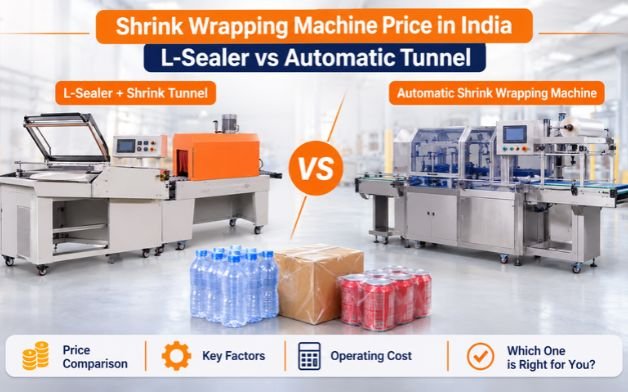
An L-sealer wraps the product in film and seals and cuts it along two sides in one operation. The wrapped product then moves through a heat tunnel, where the film shrinks around it. In a semi-automatic setup, an operator positions and loads each product.
Where it works well: Start-ups, e-commerce sellers, cosmetics businesses, book manufacturers, stationery suppliers and businesses handling boxed goods, particularly when pack sizes change frequently.
Trade-off: Output depends heavily on the operator and the time required to position each product. It can be economical for low to medium production volumes, but labour requirements may increase as order volumes grow.
Automatic Shrink Tunnel Machine
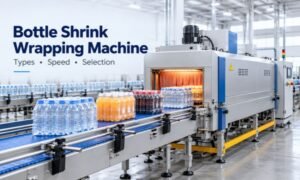
In an automatic shrink wrapping system, products move along a conveyor and pass through an automated sealing and cutting arrangement before entering the shrink tunnel. Depending on the machine configuration, feeding, sealing, cutting and product movement can be integrated into one continuous process.
The finished packs are generally more consistent when product dimensions, film and operating settings remain stable. These systems can also reduce the amount of manual handling required.
Where it works well: Beverage manufacturers, FMCG businesses and pharmaceutical packaging operations with regular production schedules, uniform packs and higher daily output.
Trade-off: The initial investment is higher, the system generally requires more floor space, and technical support is important for maintenance and troubleshooting. For small production runs or frequently changing pack sizes, a fully automatic system may be more than the business needs.
| Factor | L-Sealer + Tunnel | Automatic Shrink Wrapping System |
|---|---|---|
| Upfront cost | Lower | Higher |
| Speed | Depends on operator and pack size | More consistent at suitable production volumes |
| Labour | Usually 1–2 operators | Depends on machine configuration |
| Pack variety | Handles different sizes within machine limits | Generally better suited to regular, uniform packs |
| Space | Relatively compact | Usually requires more space |
| Maintenance | Comparatively simple | May require trained technical support |
The Part Most Price Pages Skip: Cost Per Pack
The machine price is only one part of your three-year operating cost. A better way to compare two machines is to calculate the cost of wrapping each pack.
Cost per pack = (Film + Power + Labour + Maintenance) ÷ Number of Packs Wrapped
Here’s a simplified, illustrative example. Say you wrap 1,500 packs a day.
- L-sealer setup: 2 operators (₹1,400/day) + film (₹600) + power (₹150) = ₹2,150, or approximately ₹1.43 per pack.
- Automatic setup: 1 operator (₹700) + film (₹500) + power (₹350) = ₹1,550, or approximately ₹1.03 per pack.
The estimated difference is ₹600 a day, or ₹15,600 a month, assuming 26 working days.
If the automatic machine costs ₹6 lakh more, it would take approximately 38.5 months to recover that additional investment through these operating cost savings alone.
At 6,000 packs a day, the calculation could be very different because labour requirements, production capacity and operating costs may change with volume.
These figures are examples, not industry benchmarks. They exclude maintenance and repair costs and assume that the stated labour savings represent actual savings to the business. Replace them with your own wages, film consumption, electricity rates and production figures before making a purchase decision.
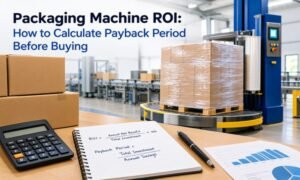
The important point is that production volume and actual operating costs determine which machine offers better value. Once you have your figures, our guide to packaging machine ROI and payback period explains how to calculate when a machine can recover its investment.
Five Questions to Ask Before Accepting Any Quote
- Are the tunnel, conveyor, GST, transportation and installation included in the quotation?
- What is the actual packaging speed for my product and pack size, rather than the maximum speed mentioned in the brochure?
- What does the warranty cover, and which components or services are excluded?
- Who will handle installation and servicing, and what is the expected response time?
- Can I test my own product on the machine before making the payment?
If a supplier cannot arrange a product trial or explain the machine’s suitability for your pack, it is worth discussing this before placing an order.
Mistakes We See Often
- Comparing a quotation that includes a shrink tunnel with one that covers only the sealer.
- Choosing a machine based on its maximum advertised speed rather than its actual speed with your product.
- Forgetting to check whether the tunnel opening can accommodate the tallest or widest product.
- Using an unsuitable film thickness, which can result in weak seals, excessive shrinkage or damaged packs.
- Skipping a product trial before finalising the machine.
When Shrink Wrapping Isn’t the Right Choice
If you’re packing heavy pallets or large loads, a stretch wrapping machine is generally the better option. For bundling cartons, long items or heavy products, a strapping machine may be more suitable.
Shrink wrapping is primarily used for individual products, boxes and multipacks where a close-fitting film finish is required. Choosing the right packaging method before purchasing machinery can help avoid unnecessary investment.
Quick Decision Guide
- Low to medium volume or mixed pack sizes: Start by evaluating an L-sealer with a shrink tunnel.
- High, steady volume with uniform packs: An automatic shrink wrapping system may offer better long-term operating value.
- Unsure: A semi-automatic setup can be a practical starting point, with automation considered later as production requirements increase.
FAQs
Does the quoted price usually include the shrink tunnel?
Not always. Some suppliers quote only the sealer, while others offer a complete system with a tunnel and conveyor. Ask for a detailed breakdown and get the included components confirmed in writing.
Is an L-sealer enough for a small business?
Yes, it can be suitable if your daily production volume is modest and your pack sizes vary. It offers a relatively economical way to achieve a shrink-wrapped finish without investing in a fully automatic system.
Can I move to an automatic machine later?
Yes. Many businesses begin with semi-automatic equipment and consider automation when production volume and packaging requirements increase. The upgrade will depend on the existing setup and the compatibility of the new equipment.
Not Sure Which Setup Fits Your Product?
The right machine depends on what you’re packing, your pack dimensions, film requirements and daily production volume. Share these details with a packaging machine supplier to understand whether an L-sealer or an automatic shrink wrapping system is more suitable for your operation.
A comparison of the available machine configurations and a product trial can help you make a more informed decision before investing.