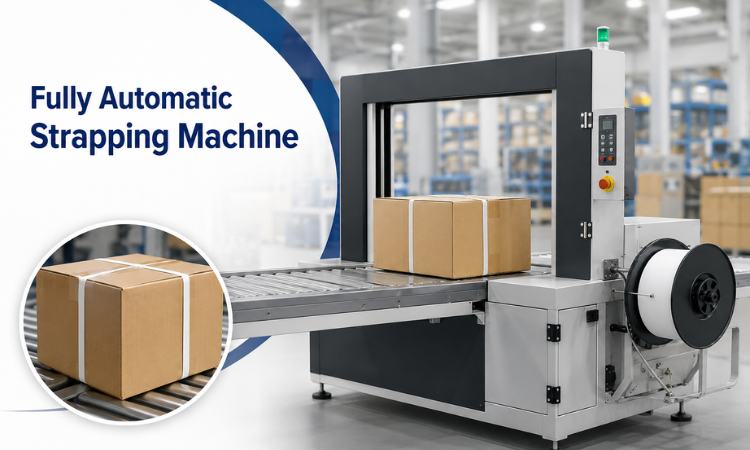
Fully Automatic Strapping Machines are becoming a game-changing solution for packaging companies. The industries are growing at a rapid rate, and now they are demanding faster and smarter packaging systems.
Why? Because large businesses handle thousands of products every day. This means speed, consistency, and safety are some essential factors for packaging and operations.
Notably, manual packaging methods are often slow and need skilled labour. Automatic packaging improves efficiency, reduces time and costs.
But these are not the only benefits of fully automatic strapping machines. In this blog, we will discuss that and find out how Packaging automation has become one of the most effective industrial packaging solutions.
What is a Fully Automatic Strapping Machine?
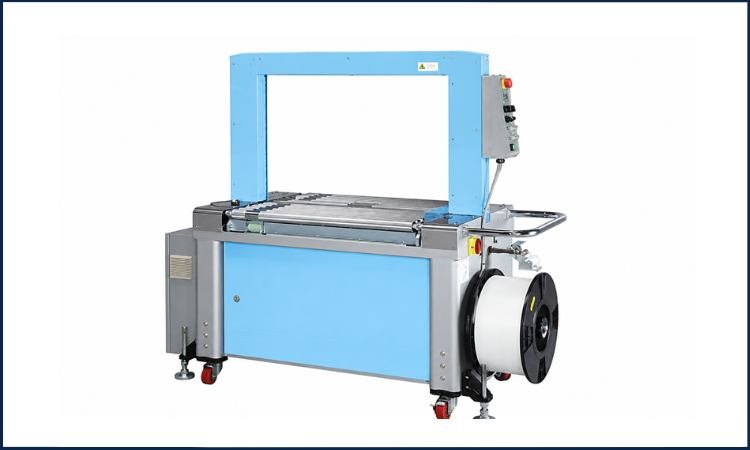
A Fully Automatic Strapping Machine is an automatic packaging machine. This secures cartons, boxes, or products with plastic straps with no manual work at all.
Unlike the traditional packaging ways, this works all the ime and helps in producing high-volume production.
This machine uses a conveyor to move cartons or products. Then the machine detects the package and applies the strap with just the right tension.
Next, it seals and cuts the strap instantly.
These automatic machines are highly valuable in the following industries:
- Logistics,
- Warehouses,
- Food industries,
- Pharmaceuticals,
- Manufacturing plants, and
- E-commerce packaging centres.
How Fully Automatic Strapping Machines Work?
Here is how a fully automatic strapping machine works:
- Products move on a conveyor belt.
- The machine automatically detects the carton.
- The strap wraps around the package.
- Automatic tensioning secures the package tightly.
- The machine seals and cuts the strap.
- The packaged product moves forward for shipment.
An automatic strapping machine works quickly and more accurately.
Since many companies look for high-speed strapping machines that can reduce the time and also serve as an effective industrial strapping machine in a heavy-duty environment.
Why Do Large Businesses Need Packaging Automation?
Large businesses look for two things:
- Managing Time
- Packaging cost reduction
Large businesses often process thousands of orders, and warehouses and factories face high pressure to deliver products as soon as possible with proper packaging.
But labour shortage, high wages, and unwanted situations cause troubles.
This is where Packaging automation solutions help.
Automated systems offer:
- High speed
- Reduce human dependency
- Increase manufacturing efficiency
- Boost packaging productivity
- Maintain consistency.
Automation helps in fulfilling customer expectations and time-bound deliveries.
Top Benefits of Fully Automatic Strapping Machines for Large Businesses:
Here are the top benefits of an Fully automatic strapping machine:
Faster Packaging Speed
Speed is one of the biggest benefits of Fully Automatic Strapping Machines.
Automatic machines can strap packages in seconds with perfect positioning and tightening. Moreover, a high-speed strapping machine can work continuously and offer better packaging efficiency in less time.
Reduced Labor Costs
Getting the right skilled laborers today is difficult. Plus, the labor cost is rising every day.
Getting a fully automatic strapping machine reduces your dependency on manual work. This means you only need your workers for unproductive work and more important operations for them.
This helps you reduce packaging labour cost and utilise your factory automation solution.
Illustrative Labour Planning Example
Many manufacturers want to understand how automation can affect staffing requirements. The exact number of workers depends on the production line, carton size, shift pattern, and machine configuration. However, the following example shows how labour requirements may differ between manual and fully automatic strapping operations.
| Daily Production Volume | Manual Strapping (Illustrative) | Fully Automatic Strapping (Illustrative) |
|---|---|---|
| 500 cartons | 2 workers | 1 operator |
| 2,000 cartons | 6 workers | 2 operators |
| 5,000 cartons | 12 workers | 3 operators |
Improved Packaging Consistency
Packaging quality always matters in shipping and logistics. While workers make mistakes, machines do the work perfectly every single time, ensuring consistent packaging quality. This reduces the risks of loose packaging or damaged packages.
Secure carton packaging offers better protection and sets the modern standards of industrial packaging systems.
Higher Productivity in Warehouses and Factories
One of the major Benefits of Fully Automatic Strapping Machines is that they offer a continuous flow of packaging. This reduces the downtime and offers continuous operations for a long time.
This improves warehouse packaging automation and increases overall packaging productivity.
Remember, a modern factory packaging system can easily manage high order volumes without slowing production at all.
Better Safety for Workers
Manual packaging is a tough process and needs fine bending, lifting, and repetitive hand movements. This may sometimes cause safety risks as well. But an automated machine minimizes the physical efforts and offers safer working conditions.
Safe packaging options reduce risks and offer industrial automation benefits beyond productivity. Also, better packaging and workplace safety mean more workplace satisfaction.
Reduced Material Wastage
Companies always look for industrial packaging optimization but packaging waste often increases operational costs. On the other hand, a box strapping machine uses accurate strap measurements and tension. This reduces material waste, improves packaging material savings, and creates an effective strapping system.
Easy Integration with Existing Packaging Lines
Fully automated strapping machines easily get integrated with existing packaging setups. They can easily connect with the conveyor belts and make the installation very easy.
With effective end-of-line packaging solutions, companies can easily improve their effectiveness with packaging line automation and an automatic packaging machine setup.
Industries That Benefit Most from Fully Automatic Strapping Machines:
Here are the top industries that benefit most through warehouse packaging equipment:
- E-commerce
- FMCG
- Pharmaceutical
- Logistics
- Textile
- Food & Beverage
- Paper & Printing
Use Cases in Manufacturing & Warehousing
These industrial packaging machines secure products before shipment. They handle bulk packaging quickly and offer reliable packaging solutions to companies.
Automatic strapping machine comparison: Fully Automatic vs Semi-Automatic
Choosing the right strapping machine depends on your daily production volume, labour availability, packaging requirements, and budget. While manual and semi-automatic machines are suitable for small or medium-scale operations, fully automatic strapping machines are designed for high-volume manufacturing environments where speed, consistency, and efficiency are essential.
The comparison below will help you understand which type of strapping machine best fits your business needs.
| Feature | Manual Strapping Machine | Semi-Automatic Strapping Machine | Fully Automatic Strapping Machine |
|---|---|---|---|
| Packaging Speed | Low | Medium | High |
| Labour Requirement | High | Medium | Low |
| Packaging Accuracy | Medium | High | Very High |
| Production Capacity | Low | Medium | High |
| Operator Involvement | 100% Manual | Partial | Minimal |
| Initial Investment | Low | Medium | High |
| Operating Cost | High | Medium | Low |
| Suitable For | Small Businesses | Medium Businesses | Large Manufacturers & Warehouses |
| Long-Term ROI | Low | Good | Excellent |
Which Strapping Machine Should You Choose?
If your business packages only a limited number of cartons each day, a manual or semi-automatic strapping machine can be a cost-effective solution. However, manufacturers, warehouses, logistics companies, and e-commerce businesses handling high production volumes should consider investing in a Fully Automatic Strapping Machine.
Although the initial investment is higher, it helps reduce labour dependency, improves packaging consistency, minimizes material wastage, and significantly increases packaging speed. Over time, these operational improvements can deliver better productivity and a stronger return on investment, making it the preferred choice for large-scale industrial packaging operations.
Key Features to Look for Before Buying a Fully Automatic Strapping Machine:
Businesses should check the following factors before investing money:
- Machine speed
- Strap compatibility
- Durability
- Maintenance requirements
- Power consumption
- Automation level
- After-sales support
But here is what you must remember. The best fully automatic strapping machine depends on the packaging and volume needs. Remember, you need durable industrial packaging equipment with strong support services.
How Fully Automatic Strapping Machines Improve ROI?
One of the major mistakes people make is missing the long-term Benefits of Fully Automatic Strapping Machines.
Businesses save money by:
- Lowering labour costs
- Reducing material waste
- Faster packaging
- Reducing damaged shipment
- Packaging consistency
This means fewer returns and complaints, boosting packaging automation ROI. A smart industrial automation investment can significantly reduce operational costs over time.
Why Are Businesses Shifting Towards Automated Packaging in 2026?
Businesses today are moving towards automated packaging, and this is required because customers want faster delivery and quality packaging. A small mistake can easily ruin your image and lose you a customer.
The rise of Packaging trends in 2026, smart factory automation, is rewriting the industrial packaging rules. That’s why fully automatic strapping machines have become an essential investment for modern businesses.
Conclusion:
Industrial packaging solutions are evolving, and people are looking for faster, safer, and more efficient packaging than ever. Companies are looking for Fully Automatic Strapping Machines that improve productivity, reduce waste, and increase profitability.
In this blog, we have discussed the Benefits of Fully Automatic Strapping Machines. But before investing your money, you also need to be careful about choosing the right packaging automation systems like Dipack. This is essential because reliable partners only offer you support, long-term growth, and modern equipment.